
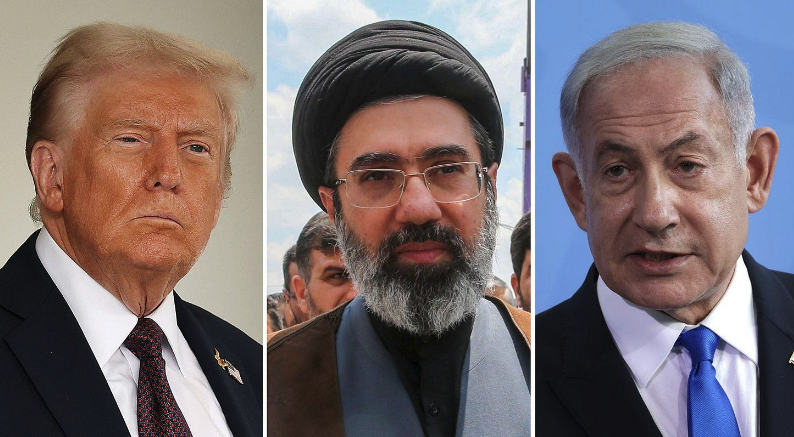
This week has been different. For the first time since the start of the war we started getting dovish signals from the US. Whatever is your opinion on the feasibility of the ceasefire, it is the first time the US publicly entertained a real option to end the conflict.
Along with this narrative, we also saw main demands from the US and Iran. Next to a “kinetic negotiation” of war, a diplomatic track was opened. While there is a long way between opening a diplomatic track (eg. the diplomatic track in Ukraine war has been open since early 2025), we now have new information that is necessary to assess.
As there is a lot of conflicting information, I need to go through both aspects of the negotiation and derive the path we are on.
The Diplomatic Track
First news of an opening of a diplomatic track hit us on Monday with this post from Trump:
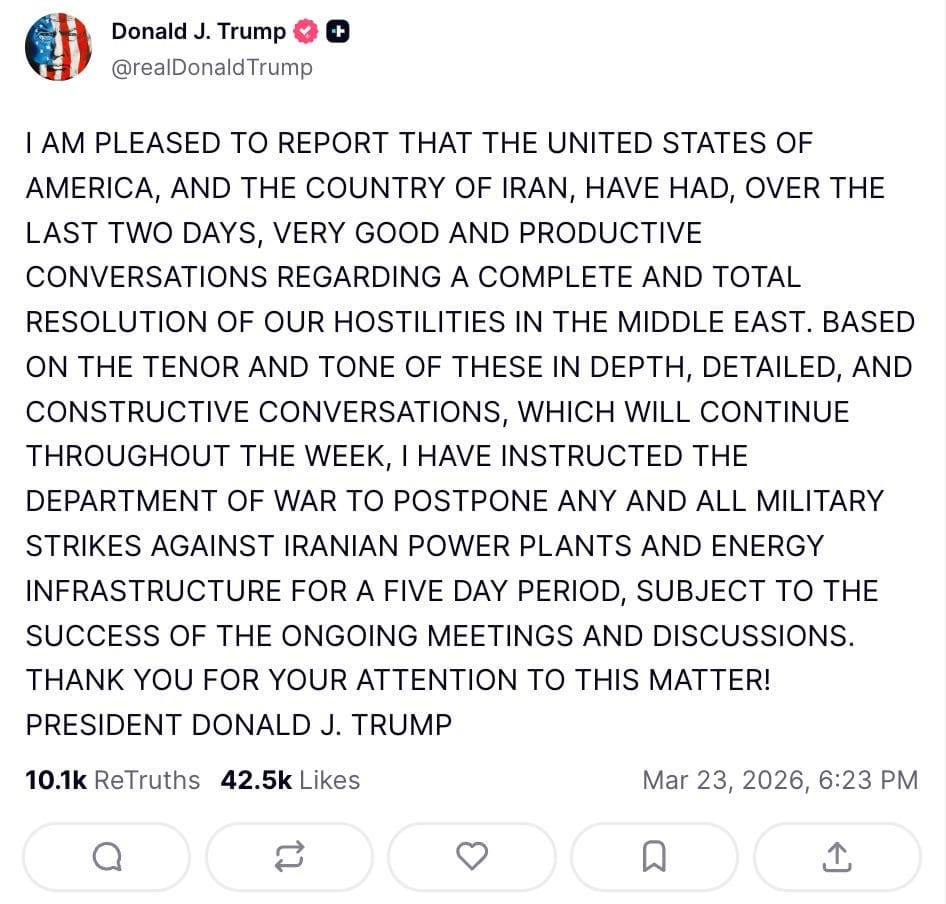
Since then we learned the respective position of the two sides with regards to ending the conflict.
The US (rumored):
- Removal of all sanctions on Iran.
- US assistance in advancing and developing a civilian nuclear project (electricity generation).
- Removal of the threat of sanctions being reimposed.
- Iran’s nuclear program is frozen under a defined framework.
- Enriched uranium to remain, but under supervision and agreed limits.
- Missile program to be addressed at a later stage, with limits on quantity and range.
- Use of nuclear programs restricted to civilian/defensive purposes only.
- Development of existing nuclear capabilities halted.
- No further expansion of enrichment capabilities.
- No production of weapons-grade nuclear material on Iranian soil.
- All enriched material to be handed over to the IAEA within an agreed timeline.
- Natanz, Isfahan and Fordow to be taken out of use (destroyed).
- International monitoring and verification mechanisms enforced.
- Gradual implementation tied to compliance.
- Additional regional and security understandings between the parties.
Iranian response:
- The enemy’s aggression and acts of assassination come to an end.
- Objective conditions are established to ensure that the war will not reoccur.
- The payment of damages and war reparations is guaranteed and clearly determined.
- The end of the war is implemented across all fronts and for all resistance groups involved in this conflict throughout the region.
- Iran’s exercise of sovereignty over the Strait of Hormuz is its natural and legal right and guarantees for the implementation of the other party’s commitments must be recognized.
These seem pretty far apart, but the real conclusion is that both sides are rather still talking past each other.
Conclusion
From the US plan we can see that top priority is the nuclear issue. Almost all points in the plan are around that issue and offer solutions that would make the US comfortable. In addition, the US is offering clear concession by being ready to drop all sanctions on Iran in return.
Additionally, we can clearly see that the issue of proxy financing and ballistic missiles is pushed towards phase 2 that might never come. It’s a classic Trump device aimed at seeking the least common denominator in the negotiations.
On the other side we have Iran singing a completely different tune. They are saying that any ceasefire must ensure long-term deterrence (along with total peace across the region) and reparations for the war. However, they also propose a solution in the terms.
Iran can treat total sanctions relief as a form of reparations. Additionally they seek an official affirmation of its right to control the strait and extract fees from the vessels. It serves 2 purposes:
- The affirmation of control in international regulations (UN could step in here) would enshrine deterrence in law.
- Fees for transit would complete the reparations part.
That being said, there is no indication of nuclear alignment between the 2 sides. Our safest assumption here would be that if deterrence and reparations are established, Iran could agree to pre-war proposals, ie. some limits on enrichment, but with an explicit approval of the nuclear programs existence. We can also say that there is alignment on most points presented by the US, on condition that Iran’s points are affirmed. Here as well ballistic missiles and proxies are left alone.
The Fight Within
We also need to remember that on both sides there are factions that are softer and more hardline.
On the Iranian side, the softer faction would agree to more concessions on the nuclear side, but the Strait of Hormuz issue is non-negotiable at this point. The more hardline faction (most likely IRGC leadership) would likely not go beyond JCPOA, but with total sanctions removal and strait control affirmation.
On the US side, the softer faction (which surely Trump also belongs to), is keen to see the war end with a win on nuclear, and could be ready to compromise on the strait issue, however it is unlikely they will agree to a full Iranian control. The hardliners (ie. the deep state + Israel + Gulf countries) see free passage through the strait as non-negotiable, with the most hardline option being no concessions at all to Iran.
If the published points offer some sort of consensus view of both sides, we can see that the main point of contestation is the Strait of Hormuz issue.
The Kinetic Track
The diplomatic track is negotiations under fire. Here as well, both sides fight for different objectives.
Round 1
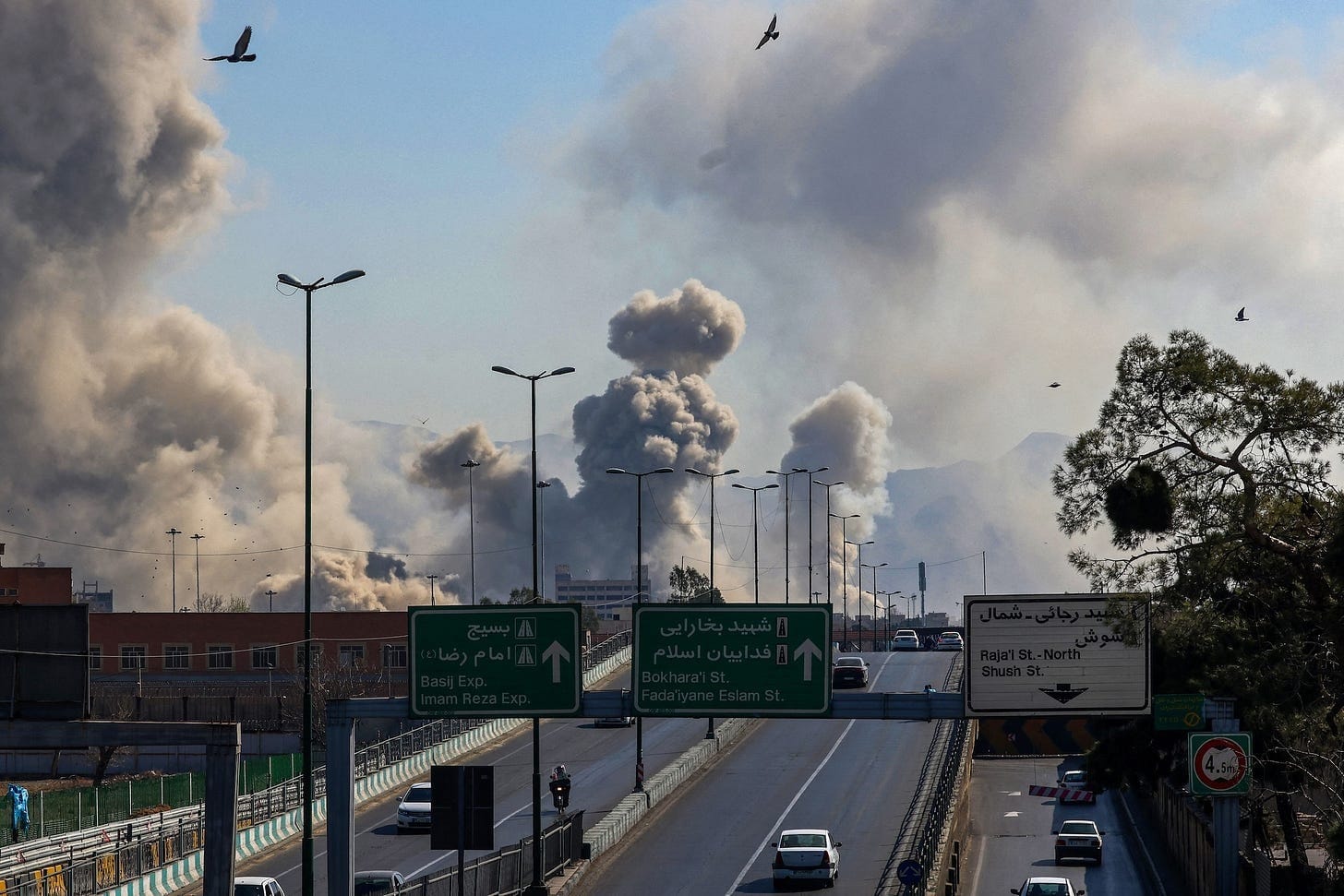
The US and Israel were aiming to disrupt the decision making process within the regime, as Israel did to Hezbollah through the pager operation and rapid decapitation of senior leadership. The aim was to significantly reduce fighting capability of the regime along with paralyzing its decision making center to force them into an ugly ceasefire negotiation.
Iran’s aim was vastly different. They expected this rapid airpower strategy and their aim was to survive decapitation, expel enemy forces from the Persian Gulf and establish control of the Strait of Hormuz.
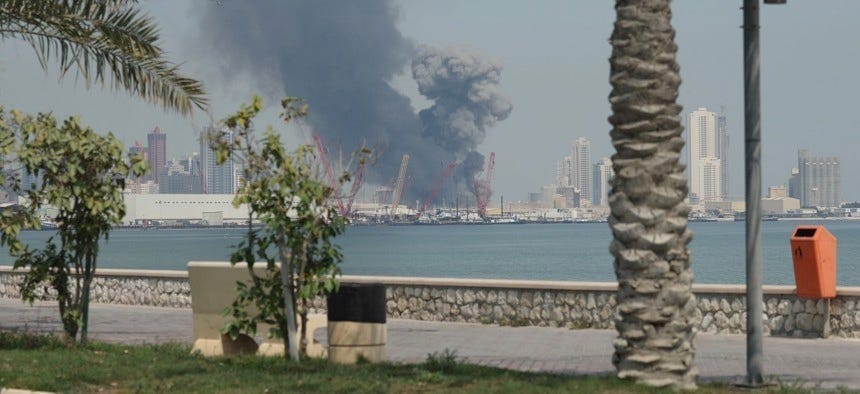
The first round ended in the Iranian win. Despite having majority of previous senior leadership killed and having severely degraded military and economic capabilities, they managed to achieve their strategic goals. Arguably, the US is in a worse position than before the war - the regime turned more hardline, survived intensive air campaign, deterred US forces from its vicinity and established control of the Strait of Hormuz.
Round 2
In round 2, Iran needs to maintain control of the Strait of Hormuz. Many analysts perceive Iranian “safe corridor for a fee” as a deescalation. After all it reestablishes some flow of traffic, in theory decreasing Iranian leverage over the global economy. In the meantime, it is phase 2 of their plan. They need to show the world that they can credibly hold the strait to force the rest of the world to affirm its control. It is in no ones interest to collapse the global economy. It is however in Iran’s interest to deny the enemy traffic and keep energy cost high to continue imposing costs on the enemy.
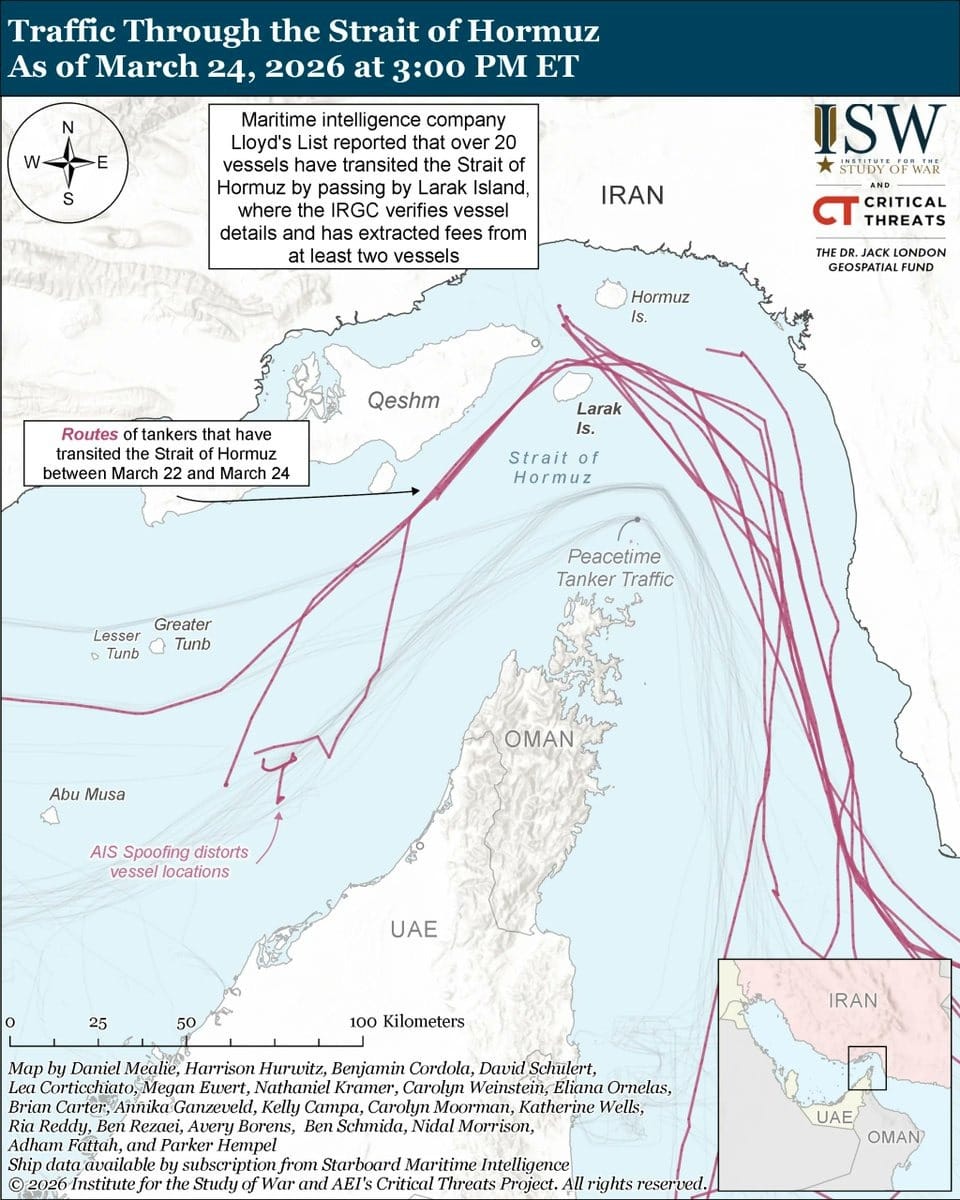
It’s a delicate balance they are seeking - hurt the global economy, but not so much so it collapses, while at the same time establish a new reality in the strait that they can benefit politically and economically from. Because in case of a total global economy collapse, they would not be able to extract fees and finance the country and the war.
On the other side, the US has 2 responses:
- Deny Iran the ability to control the Strait of Hormuz by either launching an escort operation that can bring back meaningful traffic through the strait or some kind of a ground operation aiming to establish control of the Iranian shore and islands.
- Affirm Iranian (partial) control of the strait and seek deescalation, pursuing maximalist goals in regards to key issue, ie. nuclear capability.
First choice is easier said than done. I postponed my detailed escort operation deep dive due to the emergence of the diplomatic track, however my research indicates that the US would be able to run a single convoy a day through the strait, compromising of up to 8 vessels.
Such an escort operation would require a destroyer fleet with air support, that would escort the ships all the way from the strait entry, to the ports and back. And this is without consideration for possible mines in the strait. Thus 1 convoy a day as the whole round trip would take a few days for each convoy, ie. there will be several convoys running at the same time, but in different stages (them being: entry, Persian Gulf passage, port load / reload, Persian Gulf return, exit through the strait, destroyer reloading).
Even if successful, such a solution would establish a joint control of the strait, however with Iran holding the better cards and being able to continually hurt the global economy as the US aligned traffic would be insufficient to alleviate the incoming energy shortage. 8 vessels is less than 10% of normal traffic.
It is this that leads me to believe a dual track of kinetic + diplomatic negotiations was opened. On the one hand, military assets continue to be sent to the region to allow for an escort operation and subsequent ground operation to retake the Strait of Hormuz, forced by the hardline faction. On the other hand, the softer faction opened a diplomatic track to get a feel for Iranian willingness to compromise. The opening of this track is itself interesting. Initially the US hoped it can scare Iran into concessions. However Iran, in line with its madman strategy, threatened the entire Gulf infrastructure. Its threat was believable, thus a narrative deescalation by opening the diplomatic track.
Ultimately, we need to answer 2 questions:
- Can a diplomatic solution be reached before the most intense part of round 2?
- Can the US win round 2? If so, then what?
Answers
Long story short is that I don’t believe the US is ready to affirm even partial Iranian control of the strait. Not only would such a solution enrage Gulf countries and Israel, but it would also establish a status quo that is worse than the one before the war and would be difficult for Trump to frame as a victory, even if it would resolve the nuclear issue.

I see the recent comments from some senators on the issue of boots on the ground as a sign of attempts at building consensus around the diplomatic track being made. However, it is still too early to tell whether these attempts are effective. The consensus is necessary for the diplomatic track to succeed as sanctions need to be dropped by the Congress. Strait control affirmation needs to be done through the UN. Trump cannot TACO unilaterally here. He needs broad consensus in Washington.
And here I have 3 reservations:
- Trump is not good at building consensus in Washington. He is a polarizing outsider, less so than during his 1st term, but still. He never really needed to build one, especially under pressure of the global economy. His adversaries in Washington also have good arguments - it was Trump who left the JCPOA and it was Trump who failed in the initial negotiations. They can stick it to him and simply not agree to anything that offers more concessions than the original deal while getting nothing in return. After all, there is also the midterms angle at play; this war hurts MAGA.
- The US is barely scratched. They temporarily lost a few bases, some equipment and a few lives of American soldiers. I don’t want to lack empathy here as every live lost is incredibly important, but the losses do not compare to any other US-led wars in the past. Also the US has plenty of options to escalate and unleash its military might on Iran.
- The US is not as affected by the closure of the Strait of Hormuz as Asia or Europe. They can try and mitigate the worst of the crisis for its allies, while themselves being somewhat shielded from the worst consequences of the closure for at least a few months. Yes, the US will still have inflation, some shortages and potentially a recession. But none of this is existential. They can sell and force distribution of oil & gas between allies so that the burden sharing is more fair and controlled. They can send aid to avert crisis in the most affected countries, regardless of their affiliation to avoid a regional domino effect.
For Iran, no affirmation of strait control means no reparation and no deterrence. While deterrence can be established by eg. guarantees from permanent members of the UN Security Council (China, France, Russia, UK and the US), there is no clear solution for the reparations issue as long as there is no consensus in Washington. Iran knows it is a net winner of the round 1, so if they are to give up the control of the strait, they would need to present other win to the domestic public. Especially since both sides represent a posture of readiness for round 2.
Round 2
I believe that due to the circumstances, Iran has a strategic initiative at the moment. Thus Iran’s objectives for round 2 will be of mostly defensive nature:
- Survive continuing strike campaign.
- Maintain control of the Strait of Hormuz while expanding the list of nations that can use it for a fee, forcing soft American allies to abandon the US in favor of avoiding acute energy shortage.
- Deny the US ability to retake even partial control of the strait.
The US at the same time will go on the offensive to retake the strategic initiative:
- Continue to limit Iranian ability to project power in the strait by joint US-Israeli strike campaigns.
- Try to retake the Strait of Hormuz to deny Iran’s only strong leverage.
Here, both sides have strong escalation options. The US can do anything, from an escort operation to a ground invasion. However, Iran can also do anything, from engaging Houthi in Yemen to close the Bab-al-Mandeb strait, to striking energy and desalination infrastructure in the Gulf as a deterrent to even striking the Suez canal to establish total control of Gulf flows. Not to mention striking convoys when they start to run. For now both sides agreed that energy infra should be left out of the equation, establishing soft red lines that both agree on. This consensus can be easily destroyed, but with Trump taco on Monday, I don’t see it as extremely likely.
Thus my expectation for the next few weeks is twofold. On the one hand I expect the diplomatic track to be pushed hard, especially in the media, but with no fruition as both sides are too far apart on key issues of deterrence x nuclear. On the other hand I expect more assets to be moved into the region, including allied vessels from countries like UK and France.
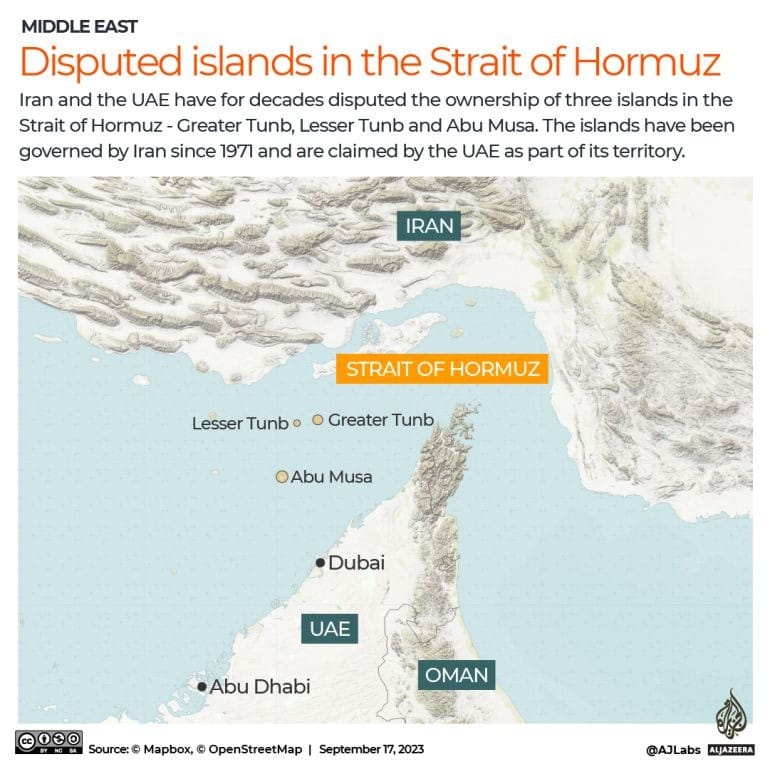
Marines and 82nd Airborne Division will most likely be used to help establish control of the disputed UAE / Iranian islands as such an escalation is a step below a ground invasion of “pure” Iranian territory. Islands will then be used to aid in an escort operation (early threat detection, surface-to-air missiles), in which a coalition of countries will participate.
Chances of success? That’s a topic for another deep dive, as is any prediction of round 3 and beyond. But these conclusions alone let us position on prediction markets with enough conviction.
Prediction Markets
Since I believe that both countries are ready to fight it out in round 2, short term ceasefire No position is the main one I am holding:
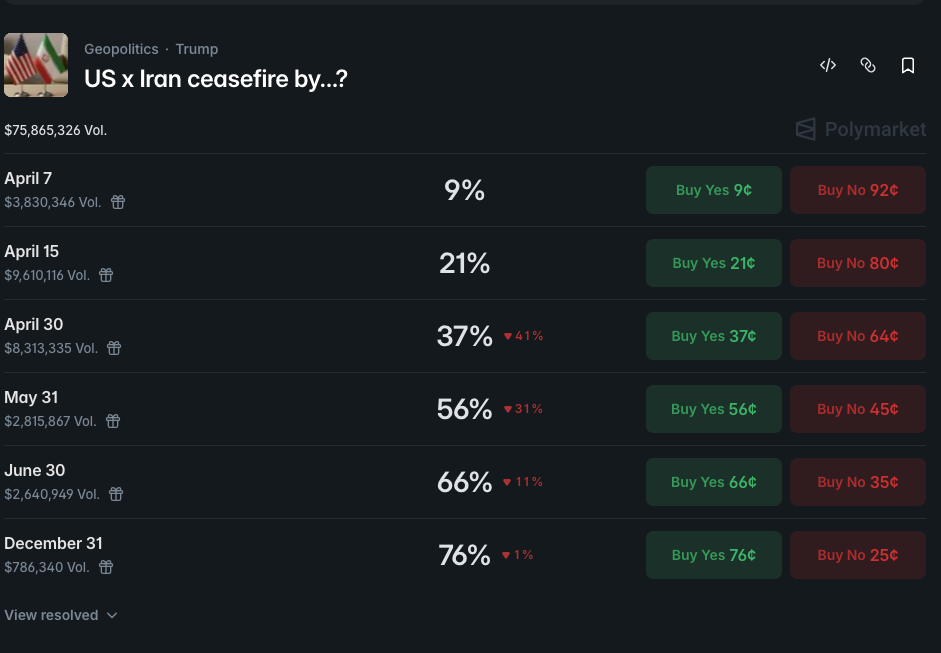
Considering that at least one Marines unit has an ETA of end of April, we can expect round 2 to last longer than round 1 (which lasted just over 3 weeks). The situation will be dynamic during that time and there are chances for de escalation, as well as escalation depending on the progress on both sides. Disclaimer: I also hold some longer dated No positions, however I bought them at the beginning of the conflict and for now I am comfortable holding them. Fair value of end of April ceasefire: 30% based on the current assessment, taking into account that the US might be quick to compromise in case of early failure in the escort operation.
Second market I am holding a position in is US forces in Iran by the end of the year:
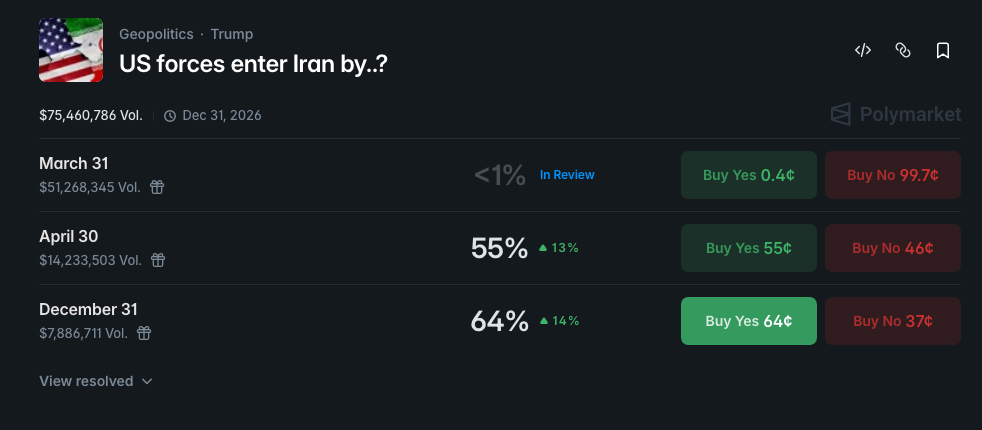
I hold Yes on the end of year market, however I don’t like any earlier strikes as end of April is a tight deadline, considering some Marines will only then arrive in the theater. Fair value by the end of the year: 80%.
Lastly, I am still holding No shares on regime change in Iran by the end of the year:
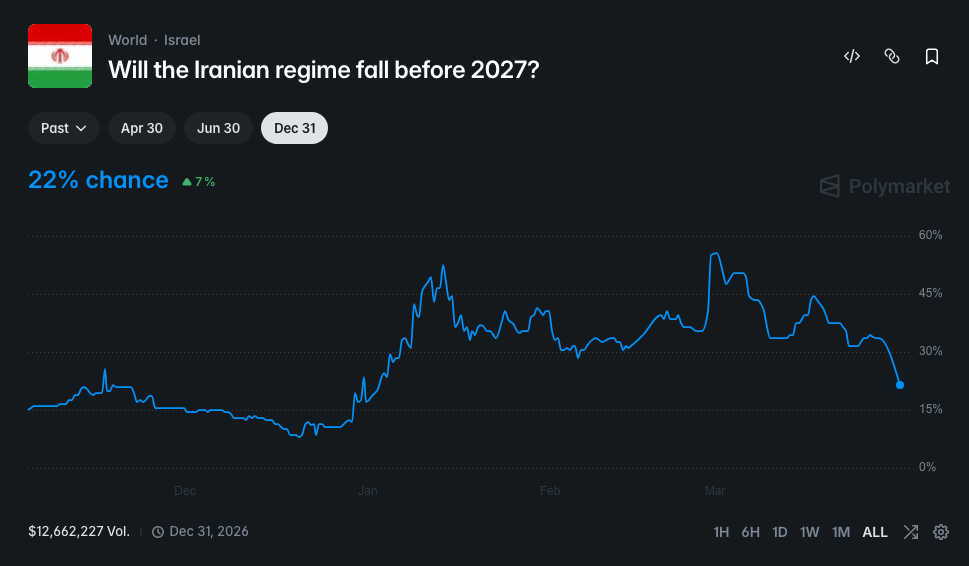
I believe that the regime’s ability to continue the confrontation is a proof of its resilience. I will only reassess my positions once I see larger US troops mobilization that will suggest a wider ground campaign. For now there are no signs of that thus fair value of No is at 80%
There are no markets on outside militias, excluding the Kurds, to enter the war. If they appear, I would be inclined to get a Yes position as I believe some turmoil at the border done through proxies might aid US effort in round 2.
Wrap up
That’s all for today. It was an unexpected article, but Monday’s developments forced me to present a coherent framework before I can engage in the Strait of Hormuz analysis. I hope you enjoyed the piece and I’d be happy to discuss it with you here or on X. Don’t be afraid to comment, the situation is extremely complex and there are no bad questions.
Stay strong and see you soon!