
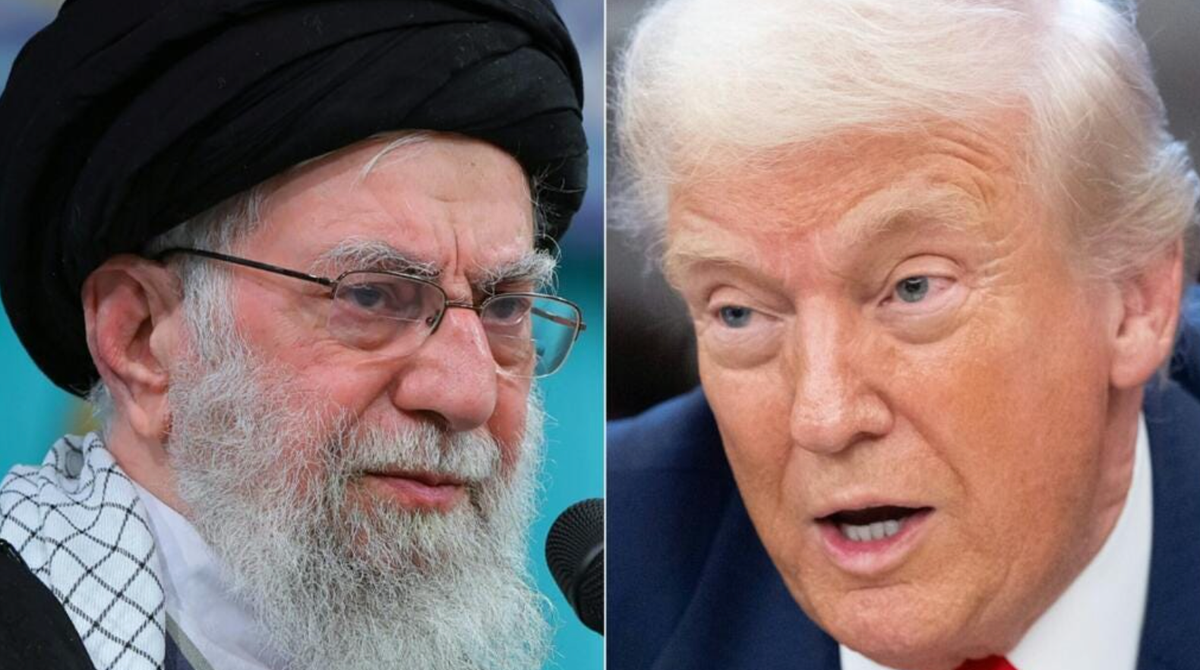
Dealmaking is an interesting process. It’s a bit like dating in your 40s - the first date is an interview, you can mingle only if goals are somewhat aligned and you can go serious very fast, but first you need to completely open your cards. At least that’s what movies make it look like.
Regardless if it’s true or not, this is business dealmaking in a nutshell. There are parties who think of working together and they need to gradually open their cards so the business goals are aligned. However, in both cases, emotions also play a role as they define the course of the negotiation.
Now, Iran and the US are on the “first date”, and one can say it went pretty well. The goals are somehow aligned (they agreed on the scope of the agreement, ie. on what goes in and what is out) and while they mingle (flex their militaries) they are discussing a serious relationship (drafting of the agreements). But can they get serious? Or will the mingling evolve into hostilities?
I fancy myself a good matchmaker, so let’s see if this relationship can work.
Most Are Looking In The Wrong Direction
My X feed, mainstream media, my friends and my neighbors - there is one thing that connects them all. They all focus on the military buildup, on the next massive airlift, on when is the next strike. See it for yourself - here are two markets. One on the deal possibility and one on the strike possibility:
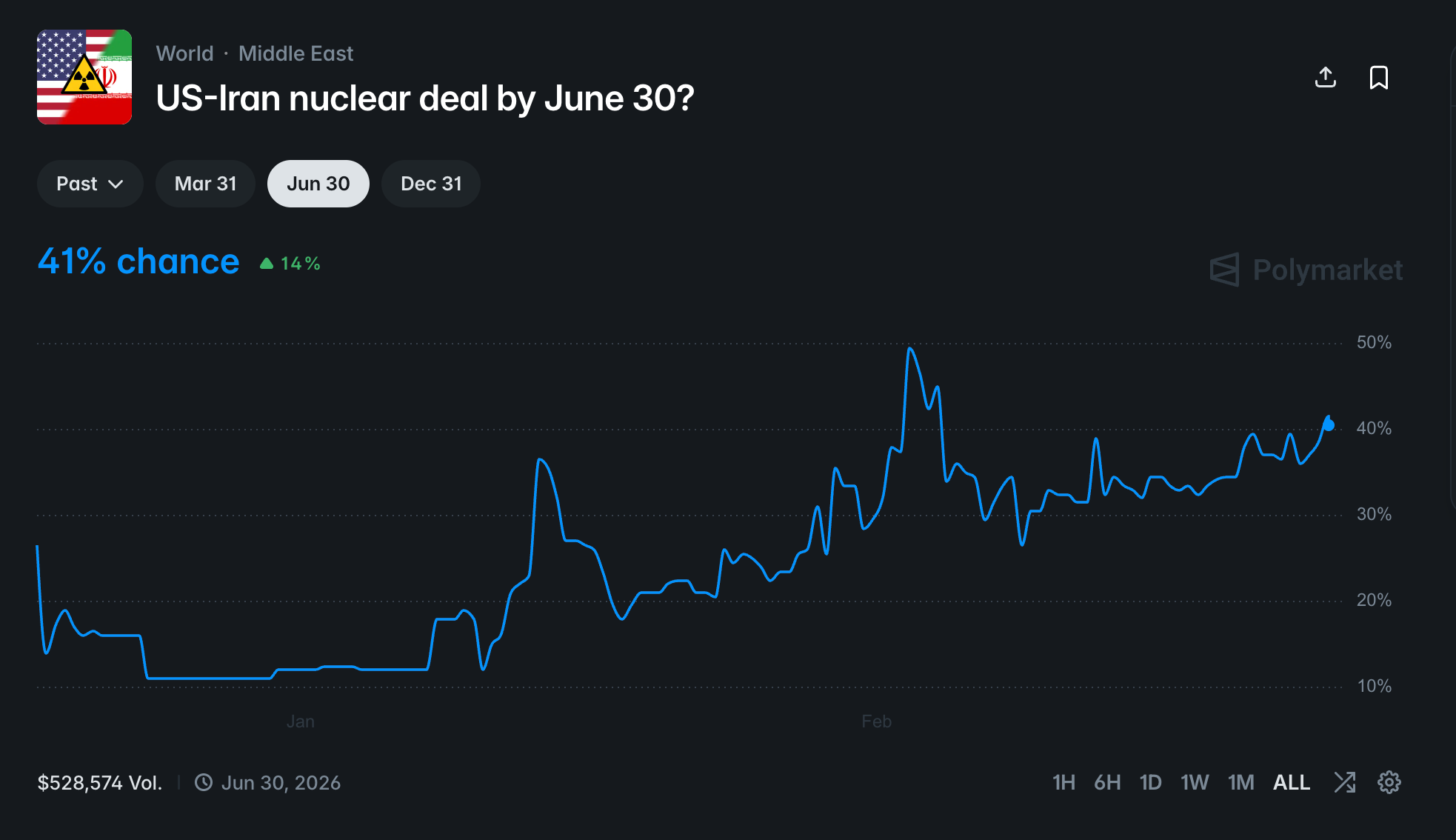
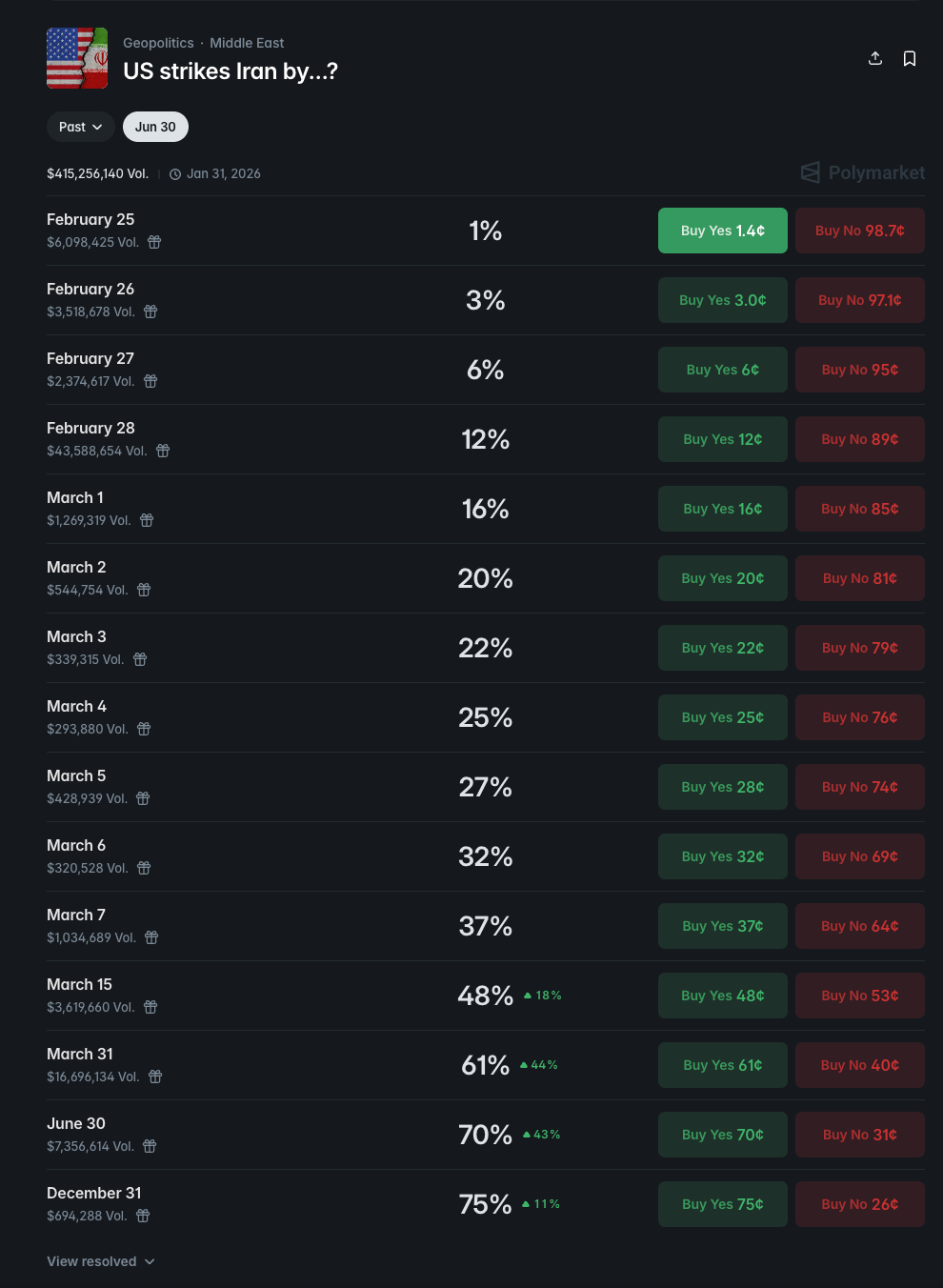
The difference in volume between these two events is staggering. Over $400 million traded on strikes and just under $0.5 million on the deal. And it makes me wonder.
War is part of politics; it’s a tool for achieving goals vis a vis other countries. War is not a goal in itself. Regime change can be. Or destruction of military/nuclear/oil facilities. But none of these are the goal. Plenty of geopolitical analysts (example here) are struggling to figure out what the massive military buildup is for, while they should pay attention to how the deal talks are progressing.
The force is there as leverage. It is there to show Iran that the US is willing and ready to pay a high price to cause pain to the regime. If the deal fails, there will be a significant kinetic escalation. Not to do regime change, or eliminate Khamenei, but to cause pain.
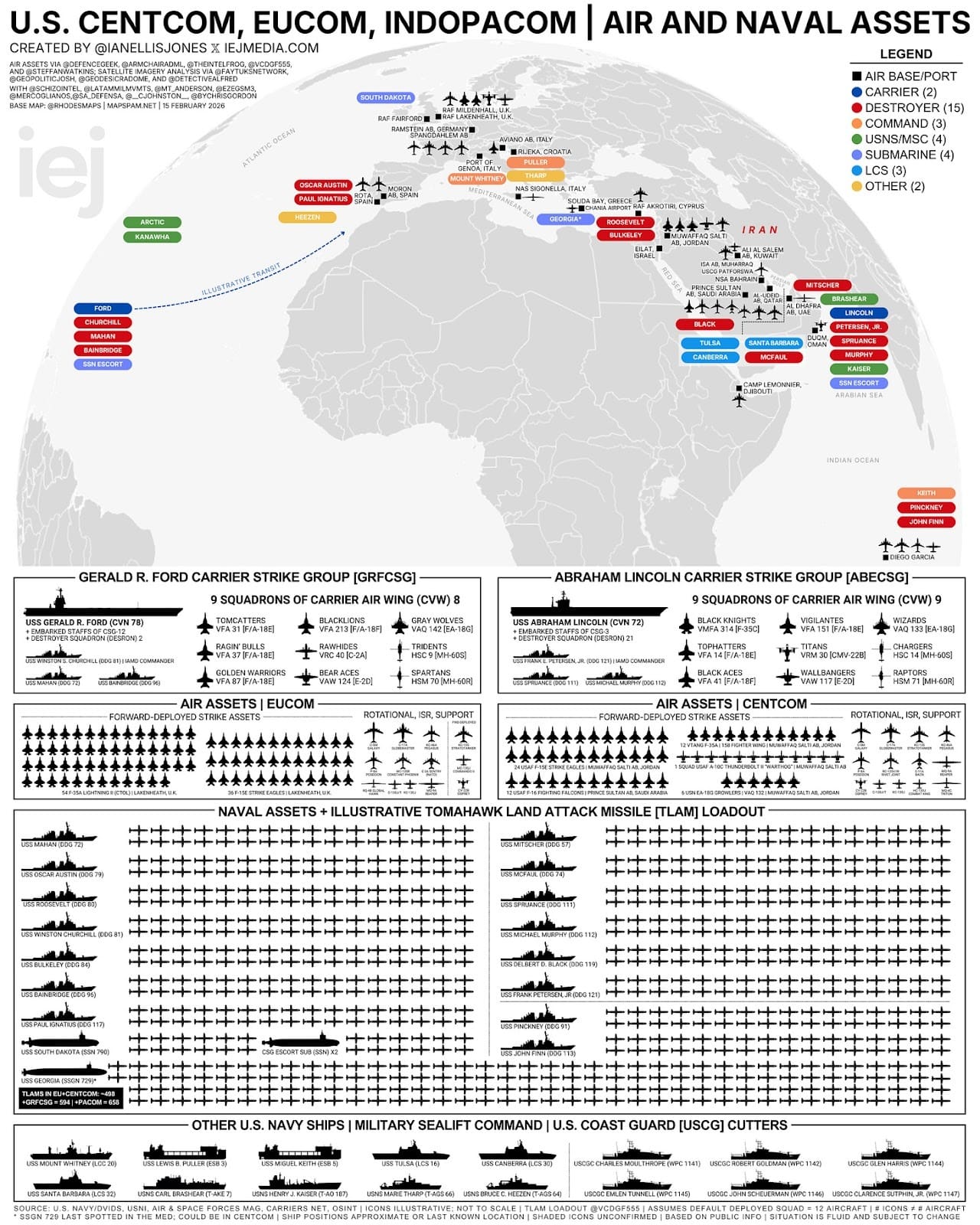
The threat of pain must be significant. Iran has previously opted for the pain, as always it was able to weather the storm and continue unbothered. Thus the massive buildup, Iran must believe that the US is ready to collapse the regime and deal with the consequences to deliver the kind of concessions needed to make a deal.
And the demands are high, because of Israel. They’d rather go to war with Iran and deal with the consequences, but they know they can’t do it on their own. They need the US for such a big operation, but the US is really unwilling to commit at this point. So the compromise here is max demands on negotiations.
I covered almost everything in this situation brief, but 1 issue: Trump is the foreign policy president. He was and is looking to fix America abroad to make it prosper domestically. To continue selling his agenda, which is becoming increasingly hard as the top priorities abroad are unresolved and domestically the situation is far from stable (between migration issues and COL crisis), he needs two major wins ahead of the midterms:
- Iran deal to end the Middle East primacy in foreign policy.
- Ukraine peace to show he can deliver.
And yes, I know that usually foreign policy doesn’t win elections. But then, what choice does Trump have? He can’t fix inflation, migration or lack of GDP growth (outside of AI data centers) in 6 months. He needs to sell a story, eg.: “I settled everything major abroad in 2 years, now, unbothered, with massive tariff revenue (sic!), I will fix America.” - you know the drill.
Now that the thesis is laid out, let’s focus on the deal. How can it look like? Can they come to an agreement? And what if they don’t?
The Deal
The Mechanics
Let’s start with the obvious - the US and Iran are in conflict. It’s not a kinetic war, but it is a conflict. Iran is a threat to the US and allies due to having an ability to create a nuke, its large arsenal of ballistic missiles that they produce in-house, proxy funding and open threats that it issues regularly. It’s not necessary to get any deeper into the story.
On the other side the US penalizes Iran by applying sweeping economic sanctions. They are aimed at weakening the regime gradually, due to economic deterioration and to make the development of the nuclear weapon and ballistic missiles more difficult.
Thus any kind of deal is a de-escalation deal - an economic warfare ceasefire. A step back on nuclear capabilities should come in tandem with some kind of sanctions relief.
However, there is a lot of nuance there. The US cannot allow for a significant sanctions relief as then Iran can easily default to funding proxies in the region. But it needs to be a meaningful gain for the regime as otherwise, there is no use in negotiating.
But let’s take a step back here. We know that any deal with Iran is a difficult feat.
The Structure
I believe that Trump will default to his favorite style of an agreement - a tiered one. Since his inauguration the deals that are being pushed in difficult situations include phases. We start with phase 1 - easy points that the parties can agree to - and proceed to put every other issue in phase 2 and subsequent phases, where details are to be discussed post phase 1.
These are terrific deals for a politician as Trump can claim he solved the whole issue with one deal. But they are horrific when it comes to real tangible effects, because phase 2 can be reached rarely, if ever.
Anyway, since there is no goal to achieve with a military force, besides inducing pain, Trump and his team will proceed with the tried and tested framework, and will get really creative to make it happen.
USA: Minimum Viable Concessions
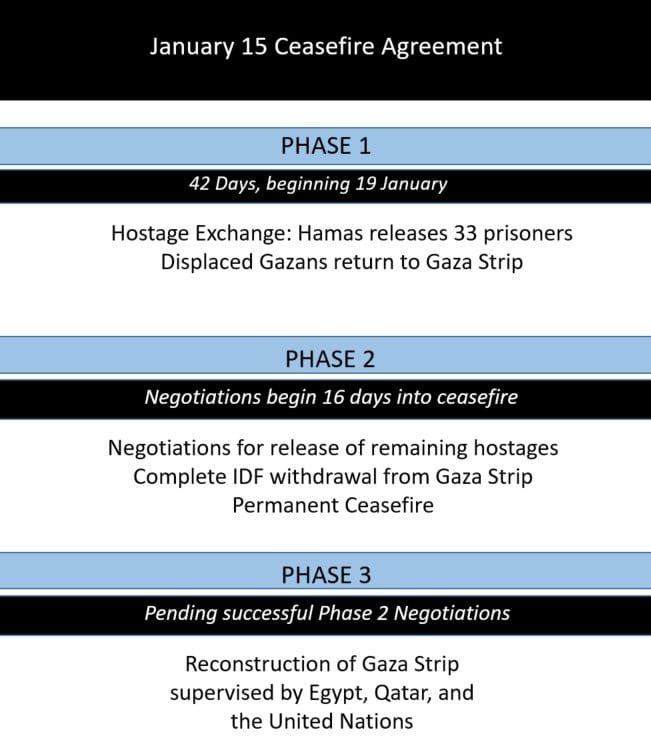
It’s a bit pointless to try and develop the whole agreement - we can expect most controversial issues like ballistic missile program or proxy funding to be loosely mentioned as discussion plans for subsequent phases of the deal. But regardless, phase 1 must include a win for the US that is undeniable. Example: a 60-day ceasefire in the beginning of 2025 between Israel and Hamas. It was obvious from the start that the proposed framework is not going to last, but a ceasefire itself was enough of an achievement to appease the American public.
Similarly here, we also have issues, that if resolved, would be enough to present the whole case as a win. This issue is nuclear weapon threat. All the rest can be collectively put in subsequent phases (which will never come).
What Nuclear Negotiations Really Are About
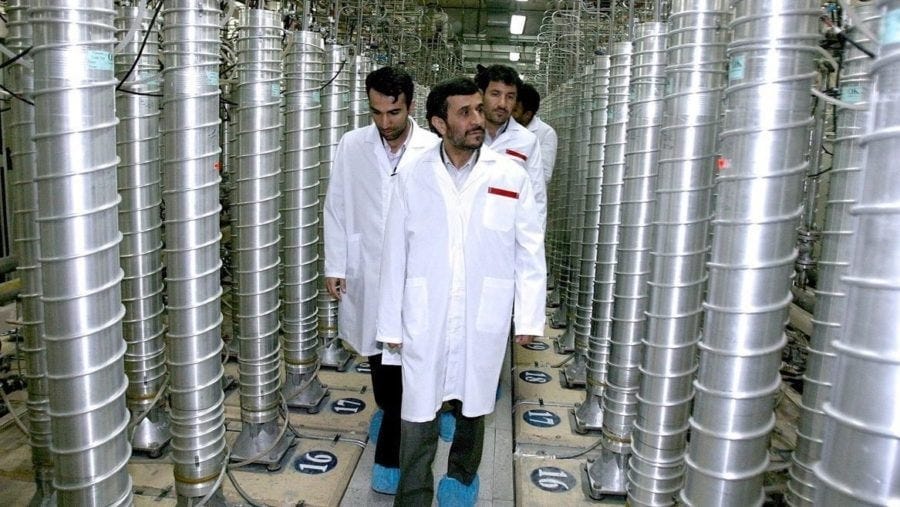
There is no way to get rid of the know-how. Iran, for the foreseeable future will have the technical ability to make a nuclear bomb. Similarly to any country that has a civilian nuclear program. The key issue to negotiate is allowed enrichment level, which directly translates into breakout time.
The JCPOA capped enrichment at 3.67% which translated to 12 months of breakout time when Iran would decide to dash for a nuclear weapon. Currently Iran is sitting at ca. 400 kilograms of 60% enriched uranium, in theory making the dash possible in days to weeks.
We can be sure that the US wants to lengthen this time, but we do not know by how much. Trump is reported to want no enrichment on Iranian soil, however last talks in Geneva supposedly opened a way towards some enrichment as long as Iran can prove is for peaceful purposes only.
Thus we can say that the old 3.67% rule is back in play as it also aligns with civilian use - this level of enrichment is necessary for nuclear power plants. But there is also trust to build. The US under Trump 1 left the JCPOA and imposed harsh sanctions on the regime. Mullahs responded by enriching uranium to shorten the breakout time and here we are.
Any new deal must include diluting the highly enriched stockpile as a starting point - a trust building exercise. Then there is the issue of monitoring, number of centrifuges, etc. But neither really shows that the program is purely for civilian purposes; after all Russia still supplies 100% of fuel to the only nuclear power plant in Iran.
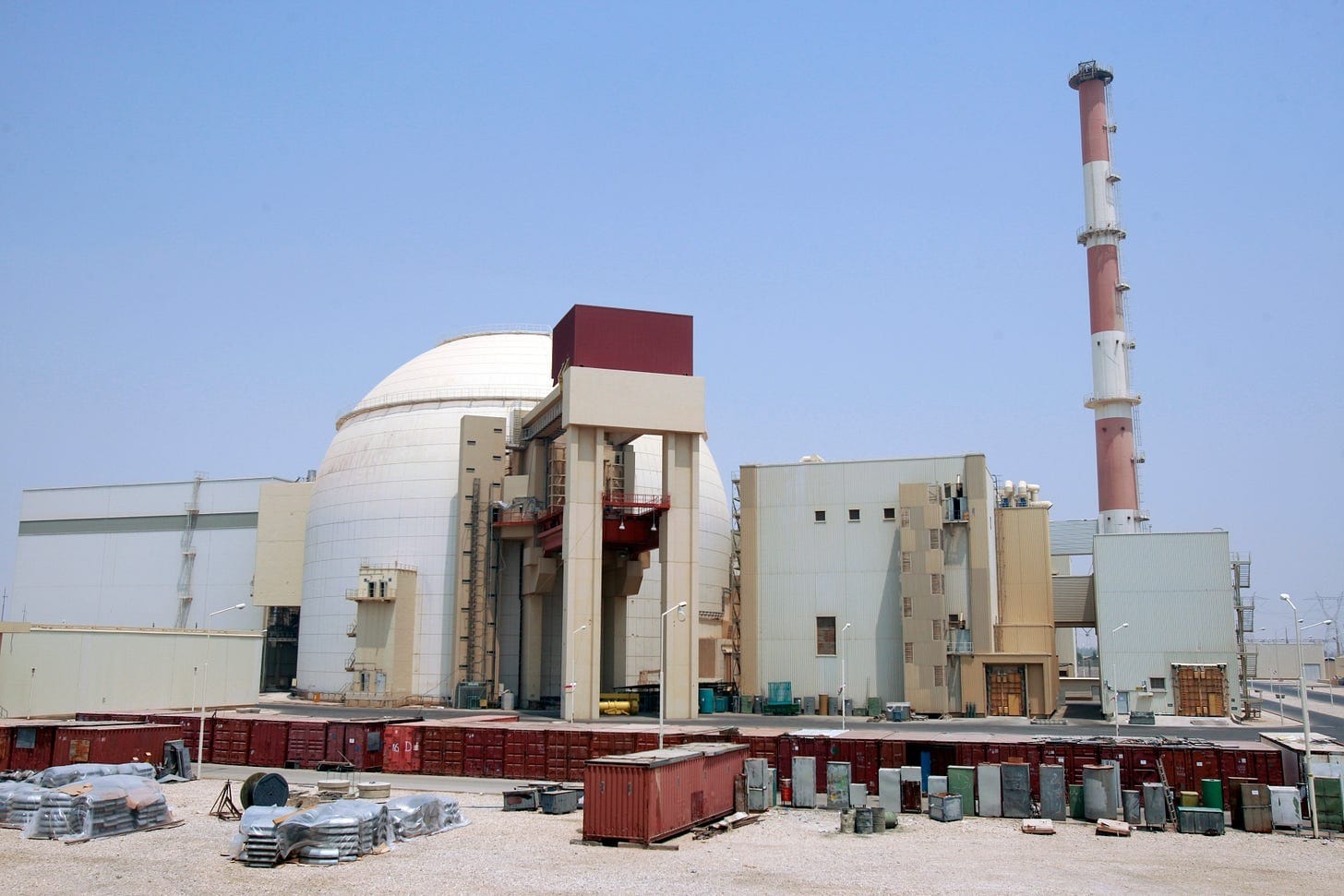
In my opinion, if Iran really wants to have a deal, they should present a roadmap to supplying that fuel themselves, including for the nuclear plants they are currently building. Can they promise it? I know that there is a memorandum of understanding between Russia and Iran that Iran is supposed to replace Russian fuel at some point. However, Russia still insists on being the sole supplier as it’s their tech (ie. the whole power plant) and they contractually need to ensure operationality.
But then, the second round of Iran-US talks was in Geneva, on the day of US-Russia-Ukraine talks, for a reason. Supplying their own fuel is the only realistic way to prove the program is for civilian purposes only. And Russia might go for it as they don’t want Iran to collapse, they need Iran to remain in team east, but they don’t want them to have nukes.
Iran: Realistic Expectations
The Islamic regime is in dire straits. Economy is in shambles, water supply is tight and inflation is tearing through people’s savings. Iran needs sanctions relief and it needs it fast.
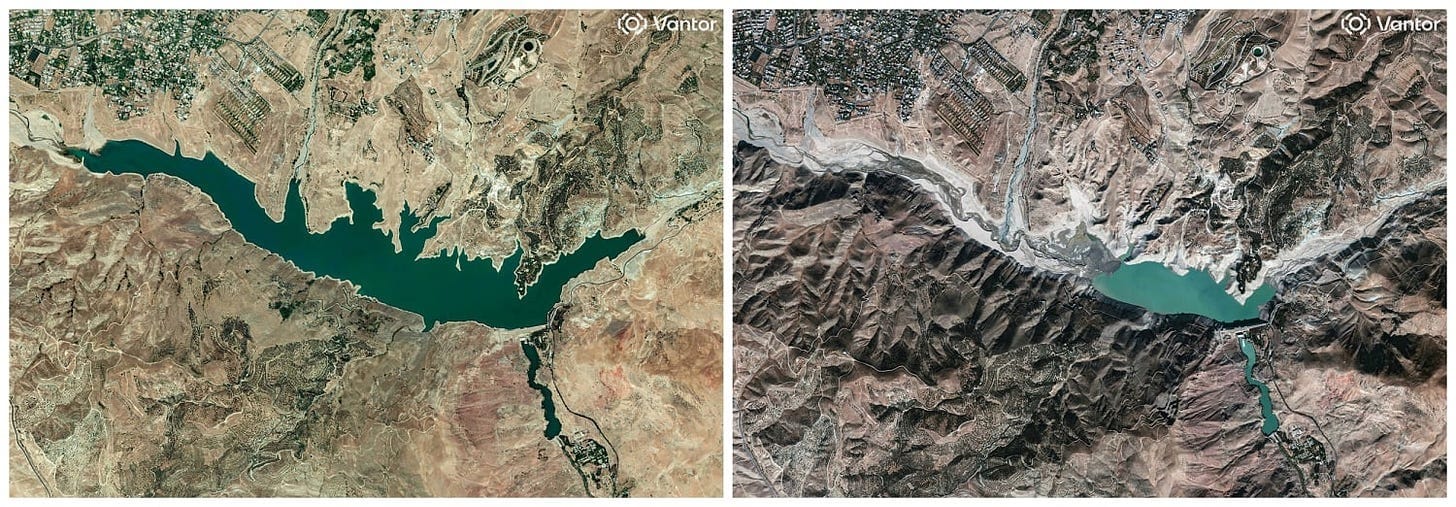
I believe that Iran will opt to propose a framework, in which it will get increasing sanctions relief for achieving certain milestones: from diluting the highly-enriched stockpile, through allowing inspections, to proving that the program responds solely to nuclear power plant needs + small amount for research purposes.
Unfortunately, sanctions on Iran are too complex to analyze which and how can be lifted. However, the question of sanctions is mostly focused on injecting Iran with cash and a worry about what will happen with it. Israel will be extremely opposed to any deal that injects Iran with cash to finance proxies. But the reality is that any concession towards Iran, will make the regime richer.
Here the situation depends on how creative can Iran get in drafting the clauses, but here are some better (and worse) ideas:
- No one is expecting the US to largely lift financial and oil sanctions. But they can create an optionality mechanism: if Iran wants to, it can sell on international markets, but revenue from sales will land on a special escrow account. Then money there can only be used to purchase goods from pre-approved vendors. Then these restrictions might be loosened with time, as Iran proves its nuclear program is purely for civilian use (milestones).
- The US can propose a barter deal, similar to one Iran probably has with China: the US will purchase Iranian exports, but not for cash. In return the US will send various pre-agreed goods that will allow the regime to prop up the economy, with the array of goods expanding as Iran proves the program is civilian only (milestones).
Both these options are just my creativity, but they come from a very simple point of view. Iran needs to appease Trump, and buying American is one sure way to do it. Ultimately Iran understands perfectly that neither team west nor team east want it to have nukes. But if it can leverage the current negotiations to secure a better deal with the US than with China, they will. Why not? If the situation changes somewhere down the line (and it will), they can always exit the agreement and pressure to renegotiate with new leverage.
At the same time, the US is also interested in cutting China off of cheap oil supply. They want to see Iranian oil on global markets, only not when it means it gives the Islamic regime money to finance proxies etc.
Prediction Markets
Ultimately it is a delicate and complex process. For me this update was not about figuring out how the deal will look like - it was a mental exercises aimed to understand if one is even possible. It is.
We also understand that both parties will be better off without a kinetic showdown. The US risks getting dragged into a prolonged conflict with a difficult enemy on a scale not seen in decades. Iran risks a collapse the moment revenues are not there for IRGC. Or water. Or pharmaceuticals. You see the picture.
Stakes are high for both parties, on the US side we can add the midterms to the mix. Trump, facing defeat, can stomach a lot of risk and a lot of concessions to get the deal done. Simply because strikes might end GOP’s weak chances of winning the midterms.
Thus I am still holding No strikes shares on end of February market. I also started to add on March 15th market and will slowly roll over my positions:
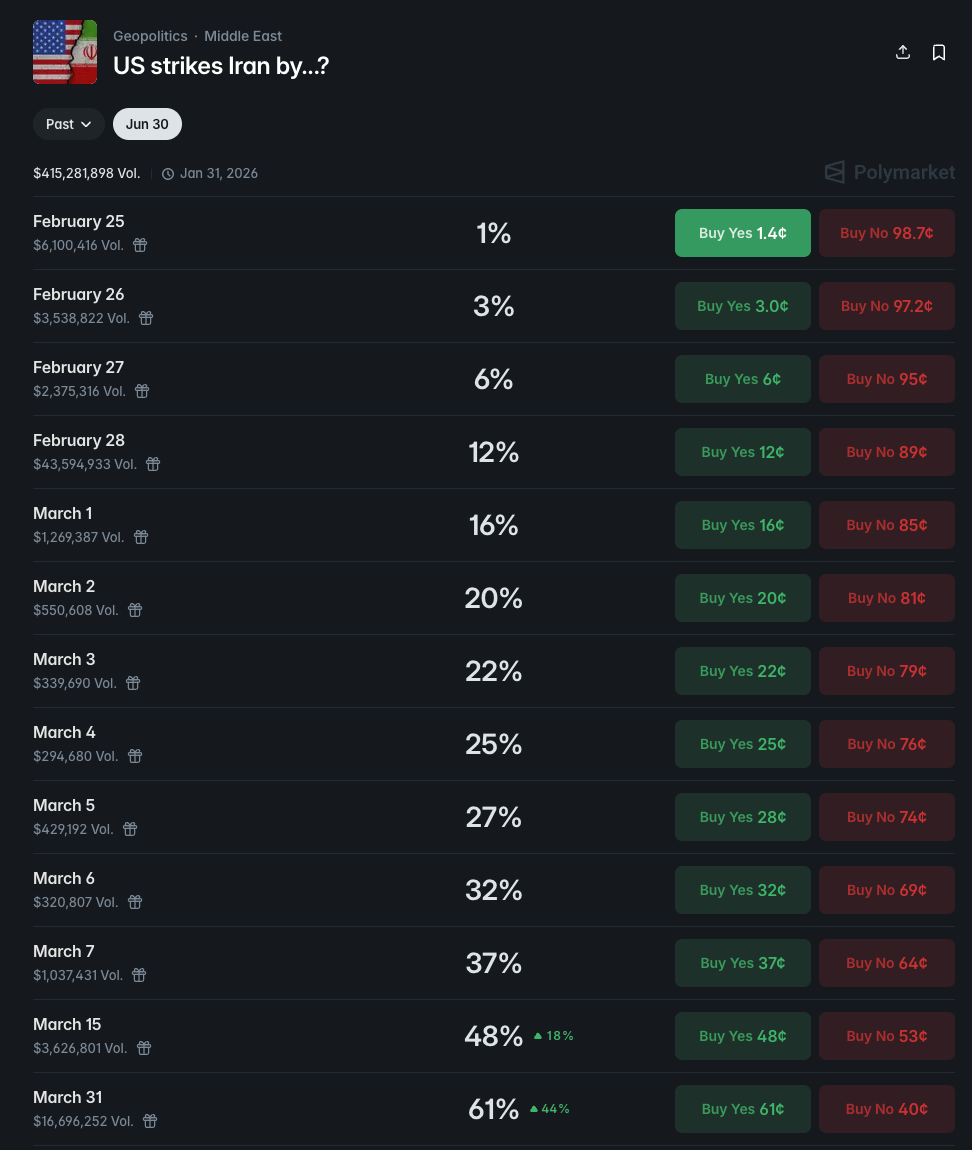
I believe that the negotiations will take quite some time. It’s a delicate and complex process after all. My overall assessment is that we have 60-80% chance of a deal and inversely, 20-40% of a strike somewhere down the line should the talks fail. However I am heavily discounting my Kelly allocation due to high uncertainty. Once we learn more, I will zero down on a precise fair value and increase sizing according to a more aggressive Kelly discount.
I also hold some end of June, but mostly end of year Yes shares on a deal being made:
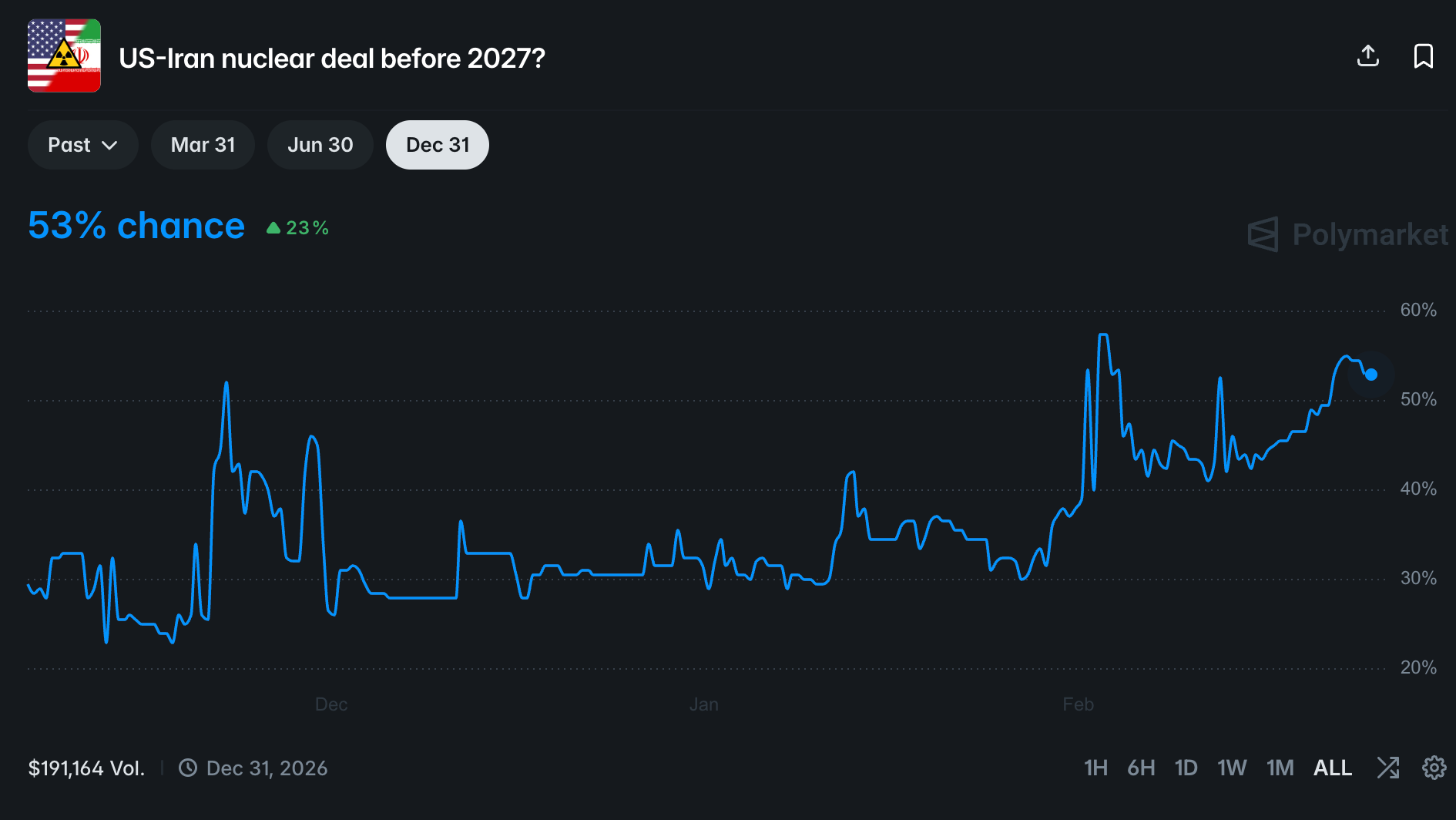
I like longer timeline better as we have very little visibility on the process. Depending on the complexity of the deal, we might run a bit outside of June 30th window.
Additionally, I believe that Khamenei out market offers an interesting addition, as even in case of strikes, even when they would be directed at Khamenei, chances are he will be able to survive:
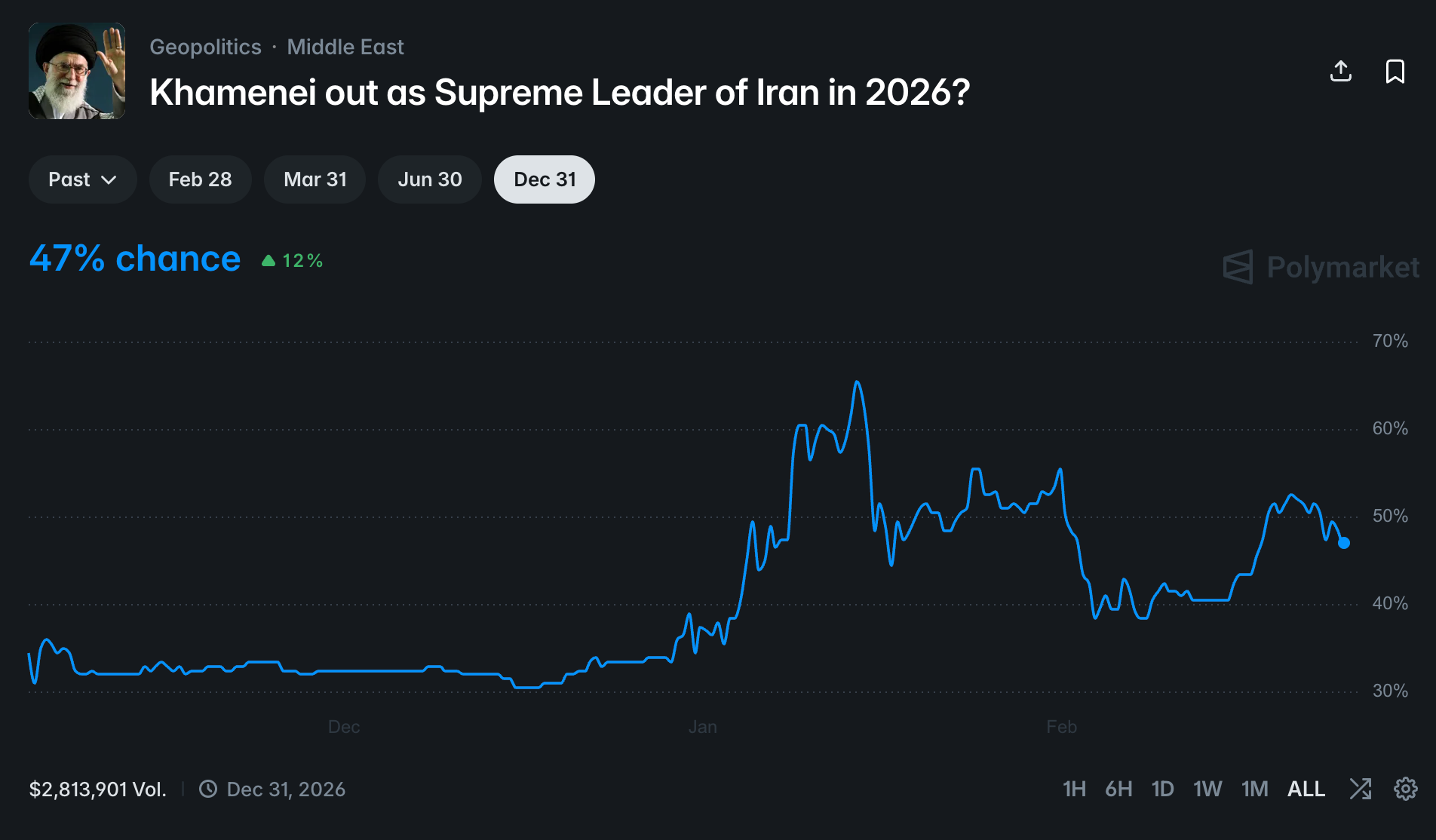
Thus I also hold some No shares on these markets, with a skew towards shorter term as it offers better APR. You are welcome to check my positions on my profile any time.
Wrap up
I want to highlight one more thing. Remember that media space, both mainstream (eg. Axios) and social, are currently filled with propaganda. Israeli officials are pretending to leak important info that in reality is a simple warmongering as it pushes their cause. People inside the administration are also arranging leaks according to which faction they belong to. Trump is doing his classic of strategic ambiguity when speaking to media. The Trump admin might also push the warmongering narrative to make Iran believe they will strike. In short, there is a whole lot of noise in the space, but very little actual signal.
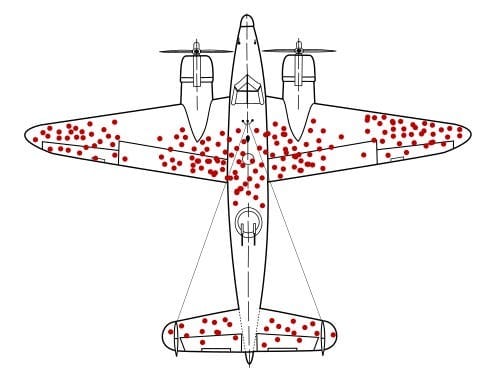
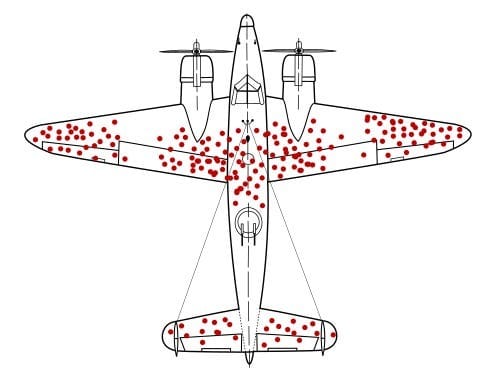
It’s no shocker that in such an environment people want to focus on the tangible, ie. the military movement to the Middle East. And that might be exactly what the US wants. It reminds me of survivorship bias a bit as there also people turned attention towards the wrong thing:
Stay strong and see you soon!