
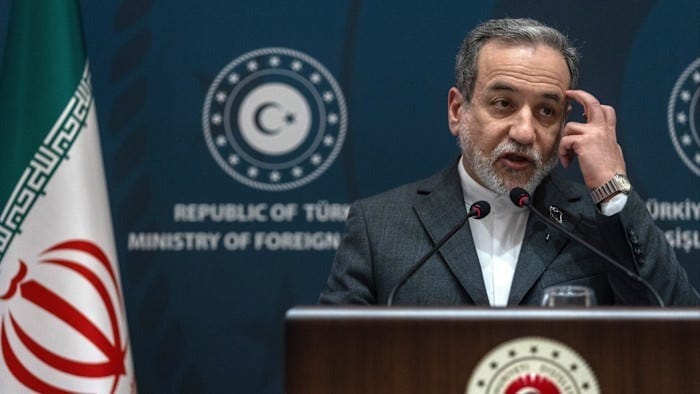
The reporting on Iran is now a cesspool of rumors. Each actor leaks whatever forwards their case. Thus at one moment we hear about imminent action, only to see that the next leak saying that Trump is still being presented and weighing different options.
People are watching Pentagon pizza reports, failing to realize the Pentagon is now randomly creating spikes to make the tool useless. I could quote plenty of other useless activities, but it all happens due to ignorant reporting.
What Are The Political Goals?
Instead of peddling each rumor like it is the ultimate truth, reporters should ask Trump about political goals. What does he want to achieve in Iran?
Is it regime change? Or is it a nuclear deal? Or maybe he just wants revenge? Or is it something entirely different like precision strikes on facilities?
Reporters are not asking this. Journalists are not trying to answer this. But this is the only question that matters as everyone is trying to understand what is going to happen. I have a decent theory of what the political goals are, but it needs an expansion now as we have official deal negotiations starting. In the previous article I was clear that Trump’s preferred path would be a deal. But is it possible?
Instagram vs Reality
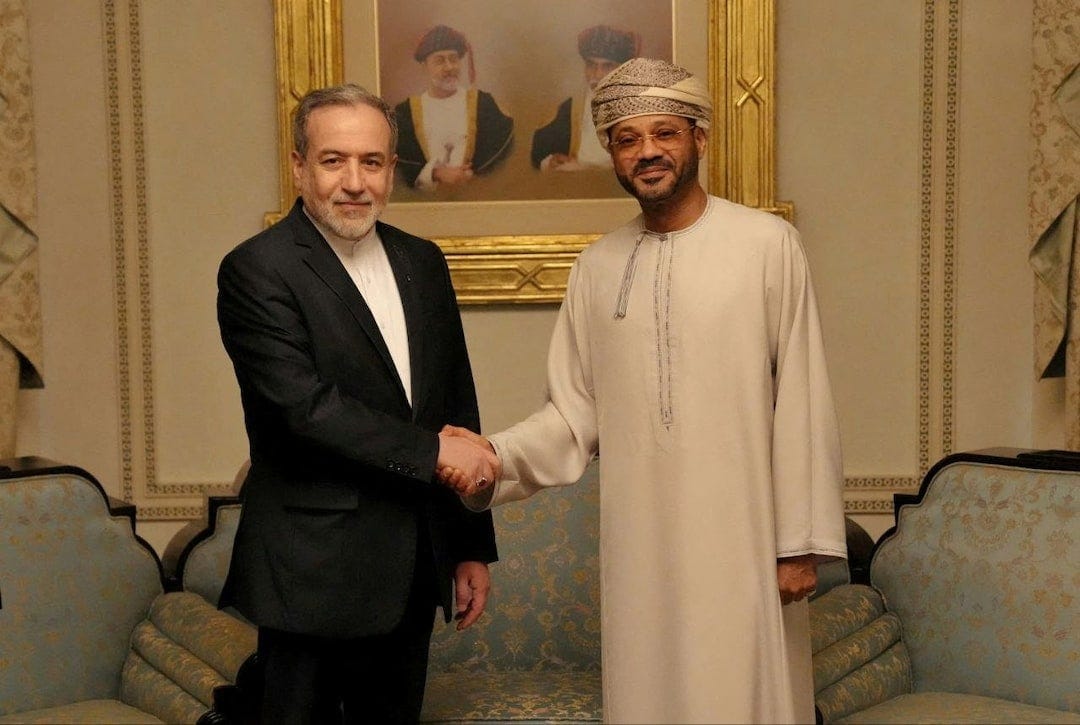
For Trump the ideal deal is the one that renders Iran militarily useless. So the full package of no nuclear, no proxies, no ballistic program, proper treatment of protesters. This is the holy grail, something that would build his legacy.
But it isn’t the only deal that is acceptable for Trump. From the political perspective, the only thing he needs to do is to trump Obama and his JCPOA. The bar is pretty low as JCPOA neither stopped the enrichment nor provided any permanent solutions. A deal that is just good enough is a one that is only marginally better. And strikes might not be necessary to achieve that.
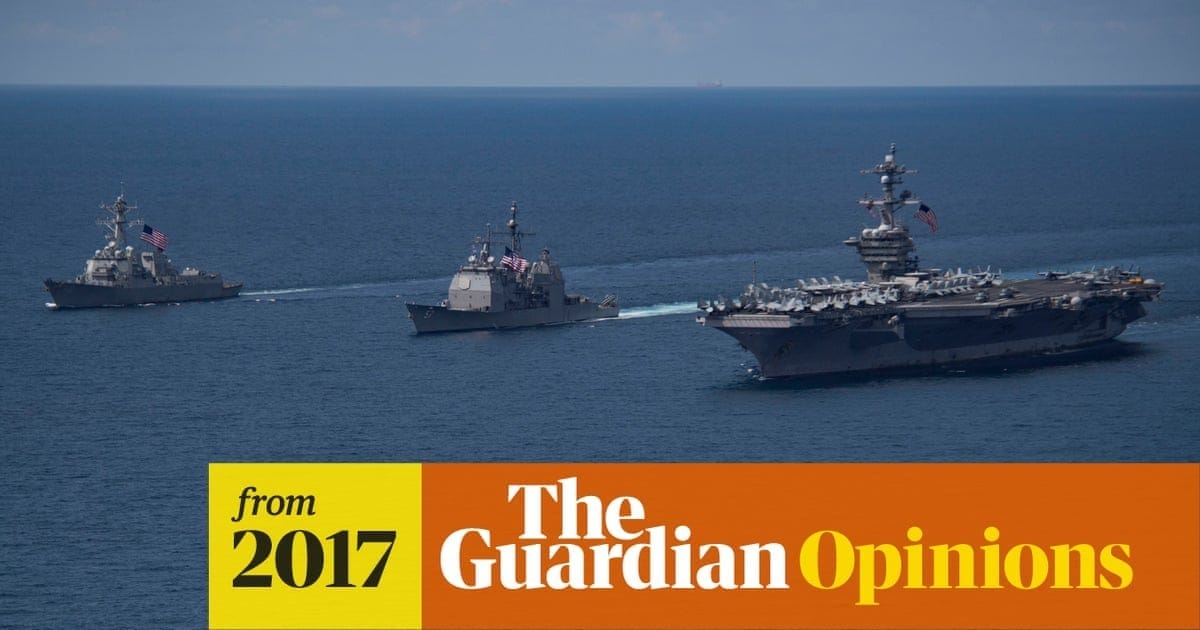
Here people usually like to categorize between the two extremes - either you believe TACO or you see Trump as someone who always keeps to his promises when it comes to foreign affairs. People of the former group based on events like Greenland or Liberation Day tariffs see Trump as this bully who, once confronted with the consequences, backs down. The latter see him as a strong protector who will never go back on his word when it comes to peace. Or wars. Or strength.
But the truth is that neither are right. Trump just has a negotiation strategy. He starts with maximalist demands to eventually end up with exactly what is needed (vis a vis political goals of course). The whole Iran situation, the military buildup, the tough posture, all the strongly-worded statements - they are all part of this strategy. However Trump is not omnipotent. Currently he faces several influences:
- ego: a need and want of personal achievement,
- midterms, divided into:
- funding: someone needs to pay,
- campaign narrative creation: you need to be able to present Ws,
- commodities: oil needs to be cheap this year; both to rein in Russia and maintain low fuel prices domestically.
The 3 Whisperers And An Adversary
Ego
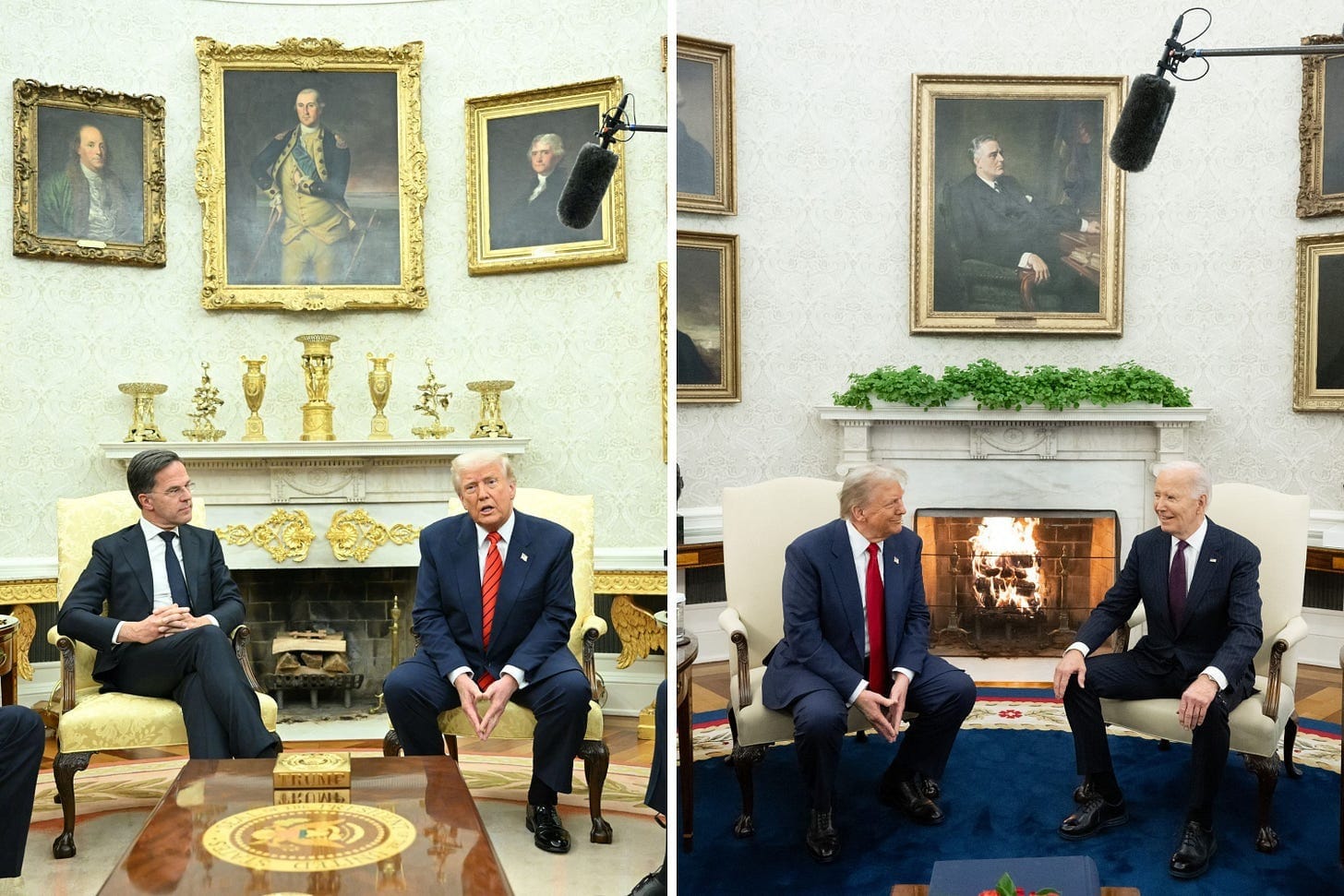
Trump loves to look good. Strong. His image won him 2 elections and made his campaign events (somewhat) fun to watch. Ultimately though, Trump needs to be better. Better than Biden. Better than Obama. Better than Bush. It’s his basic strategy: person x is bad / made a bad deal; I am better / I made a better deal.
This kind of rhetoric was used when Trump spoke about NAFTA, Afghanistan withdrawal, Ukraine war and inflation (sic!) among others. The same rhetoric was used when Trump spoke about JCPOA - a bad deal made by an even worse president. And he would love to tout the achievement of one-upping Obama here (kudos to one of my followers on X who correctly identified this).
Trump is also a sucker for prizes. And signing a nuclear deal with Iran should finally put him in a spot where he can realistically win the Nobel Peace Prize.
From the ego perspective, Trump will do everything in his power to achieve a deal. And he should be ready to do it for a long time (well, at least till the midterms, or Nobel Peace Prize announcement), as long as he can continue to show strength while doing so (ie. expect more strong messaging in the media) and showcase even minimal progress in the process.
Midterms
Funding
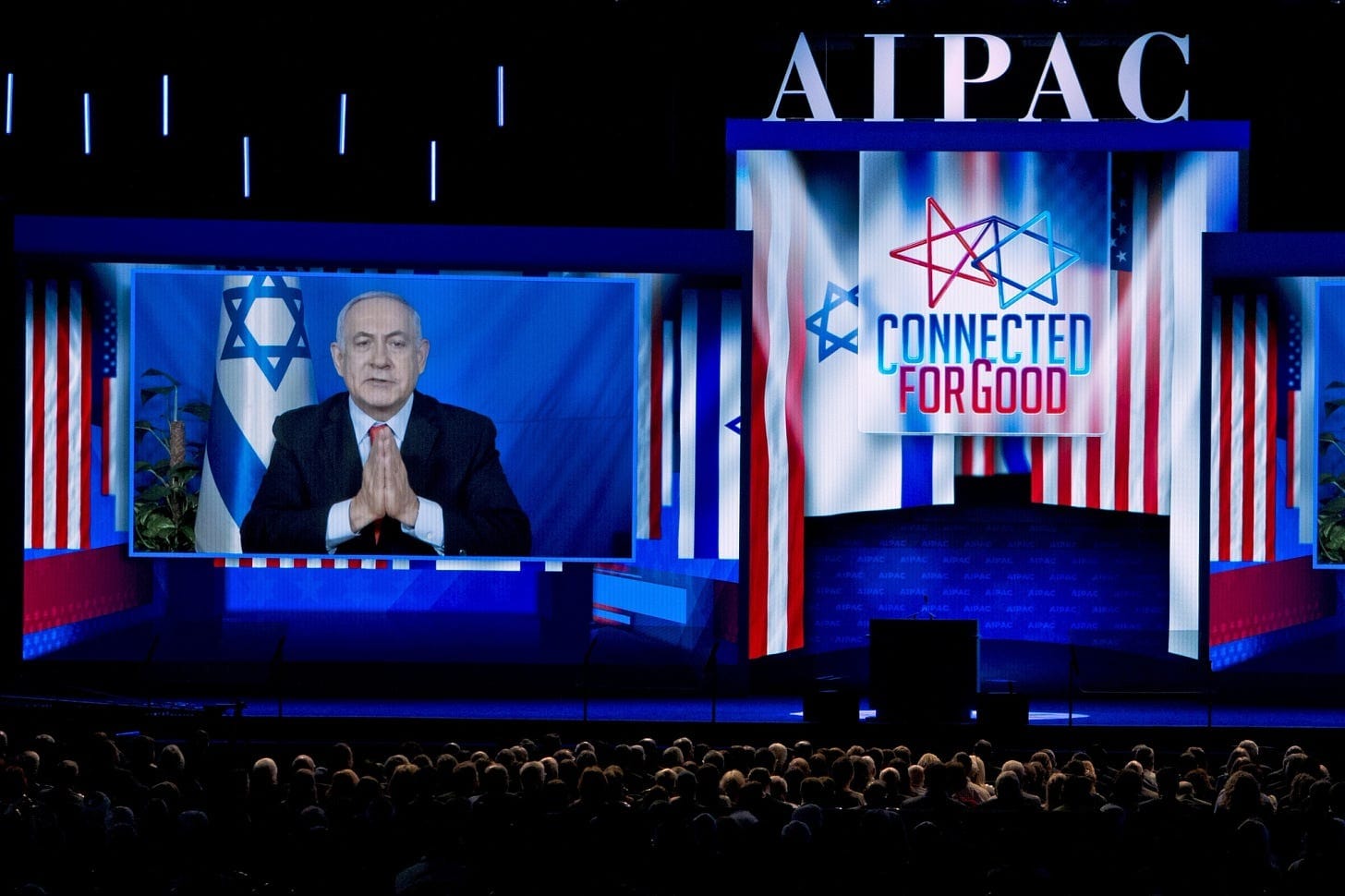
This is where interests clash. When it comes to regional actors, Israel is looking to escalate the situation to a kinetic confrontation, while other actors like Türkiye, Saudi Arabia or Egypt (or any other country in the region for that matter) are aligned with Trump’s ego.
In that situation Israel might be tempted to use the AIPAC funding leverage to pressure Trump into action. However, the effect of such action would be limited - Gulf buddies of Trump would be happy to cover the gap as long as it ensured stability in the region. Netanyahu would also be wise to not use up too much goodwill with Trump; he has domestic issues and Trump administration has been of massive assistance to him and Israel in general. Plenty of prizes to be had in Gaza.
Trump’s unwillingness to escalate with Iran comes from a simple fact - to continue implementing his agenda he needs both House and Senate. Current polling is not favorable in the House race and potentially starting a very unpopular war is not an optimal scenario.
Narrative
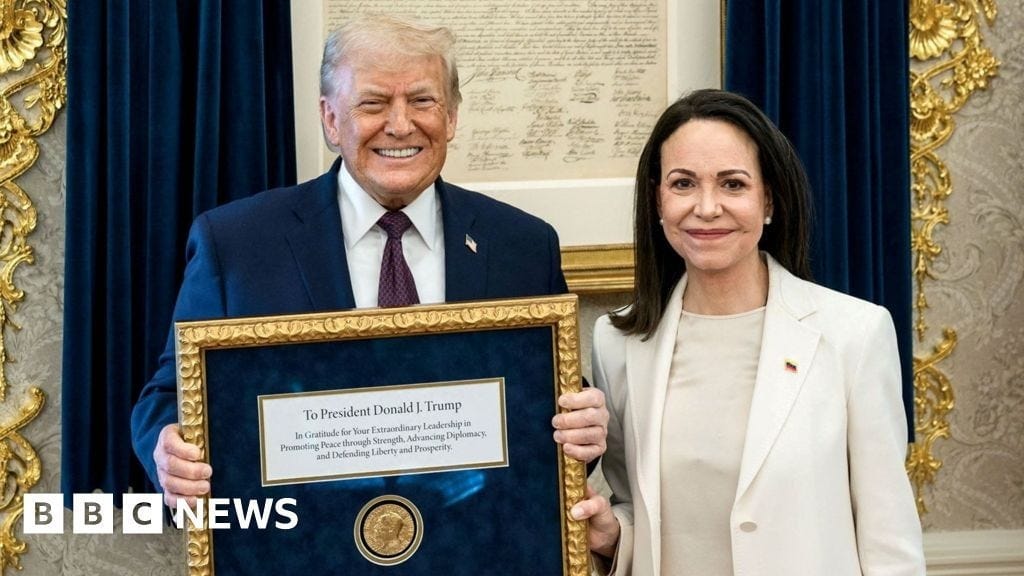
When you win elections on stopping senseless military engagements in the Middle East, you don’t escalate a potential war in the region in the year of the midterms. When you specify in NSS that the Middle East is no longer a priority and you will only be opportunistic when it comes to any military actions there, you don’t escalate a potential war in the region. When you have a massive foreign policy win (the capture of Maduro) in the midterms year, you don’t cover it up with a potential war in the Middle East, especially with such a low favorability.
You see, there is a multitude of reasons Trump shouldn’t escalate the situation. The campaign narrative you want to push as Trump is strength outside and rebuilding inside. There are plenty of global events Trump can frame as his foreign policy wins; from tariffs to the wars he ended, it all resonates well with the public. Some of the wins can be tied to domestic policy, eg. Maduro capture as both a strong move against drugs and an effort to curb illegal migration.
But when it comes to domestic policy, there are not a lot of Ws Trump can tout. He largely stopped migration, but deportations are going painfully slow. The S&P500 breaks ATHs every month, but Americans are still struggling with high cost of living. Woke might be dead, but there are plenty of protests against Trump.
In such a situation Trump might want to cover up domestic policy shortcomings with another big foreign policy win (like a nuclear deal with Iran). But he cannot risk a big foreign policy loss (like escalating a regional war in the Middle East). Because once you do that, the whole narrative crumbles.
Oil
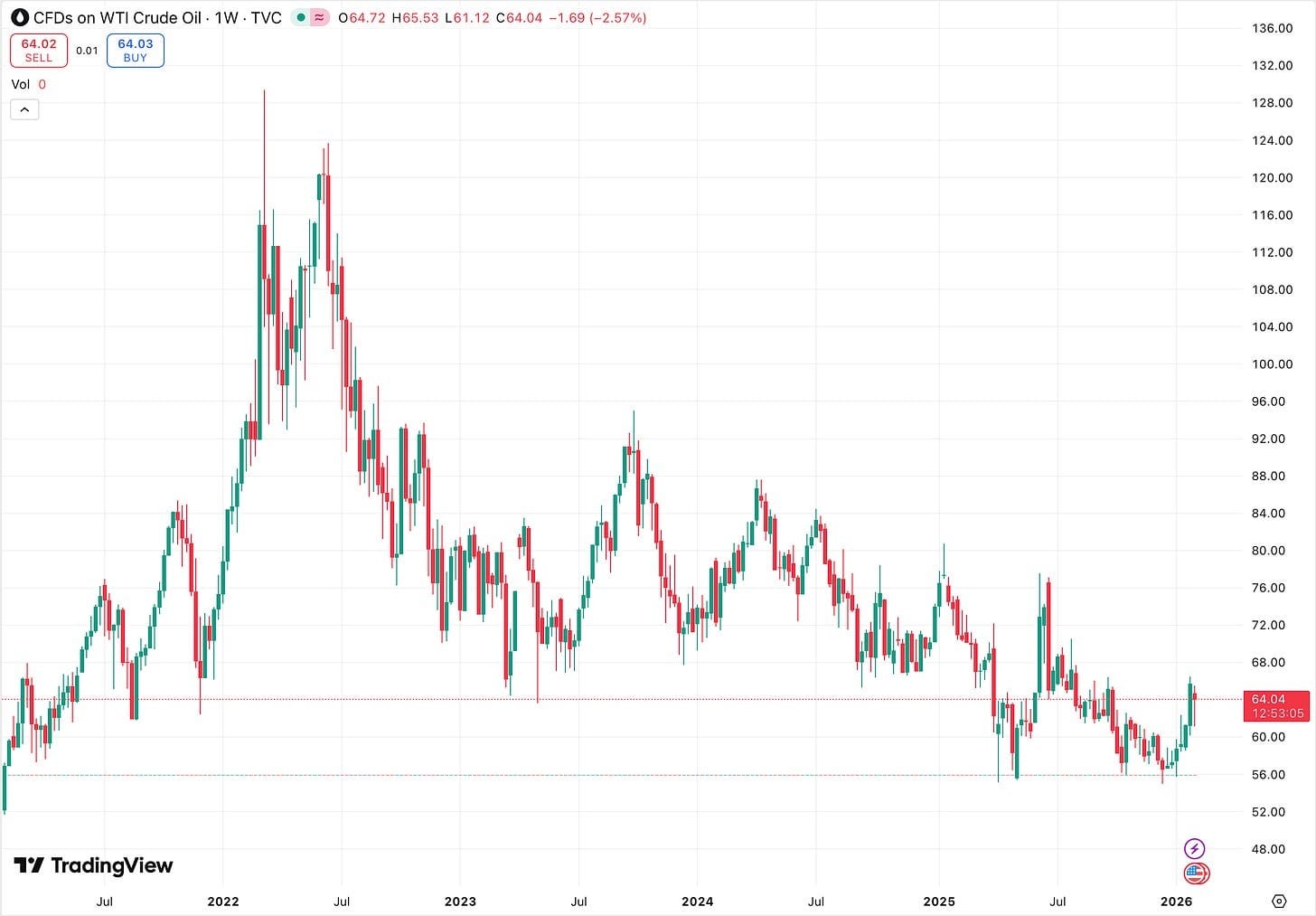
Lastly, there is an issue of oil. Any military confrontation in Iran risks the stop of oil flow and an oil price spike. If it escalates even further, the price increase will become permanent. Such an action destroys Trump’s agenda on 2 fronts:
First, by erasing Iranian oil from the market, Trump would increase the demand for Russian oil. The main importer of Iranian oil is China. Considering that China doesn’t pay market price for this oil, but rather barters for it, it would look to replace it not on global markets, but in Russia, where it can negotiate better conditions due to sanctions.
But Russian oil is not infinite. The decrease of global supply of oil would immediately push its price on global markets up, increasing the price an the pump for Americans. A low price of oil, undoubtedly Trump’s big achievement and top priority, is crucial to maintain to have any good arguments for alleviating cost of living crisis.
Simply put, Trump cannot risk a war in Iran. The combination of all of the above renders any kind of kinetic engagement deeply improbable.
Iran
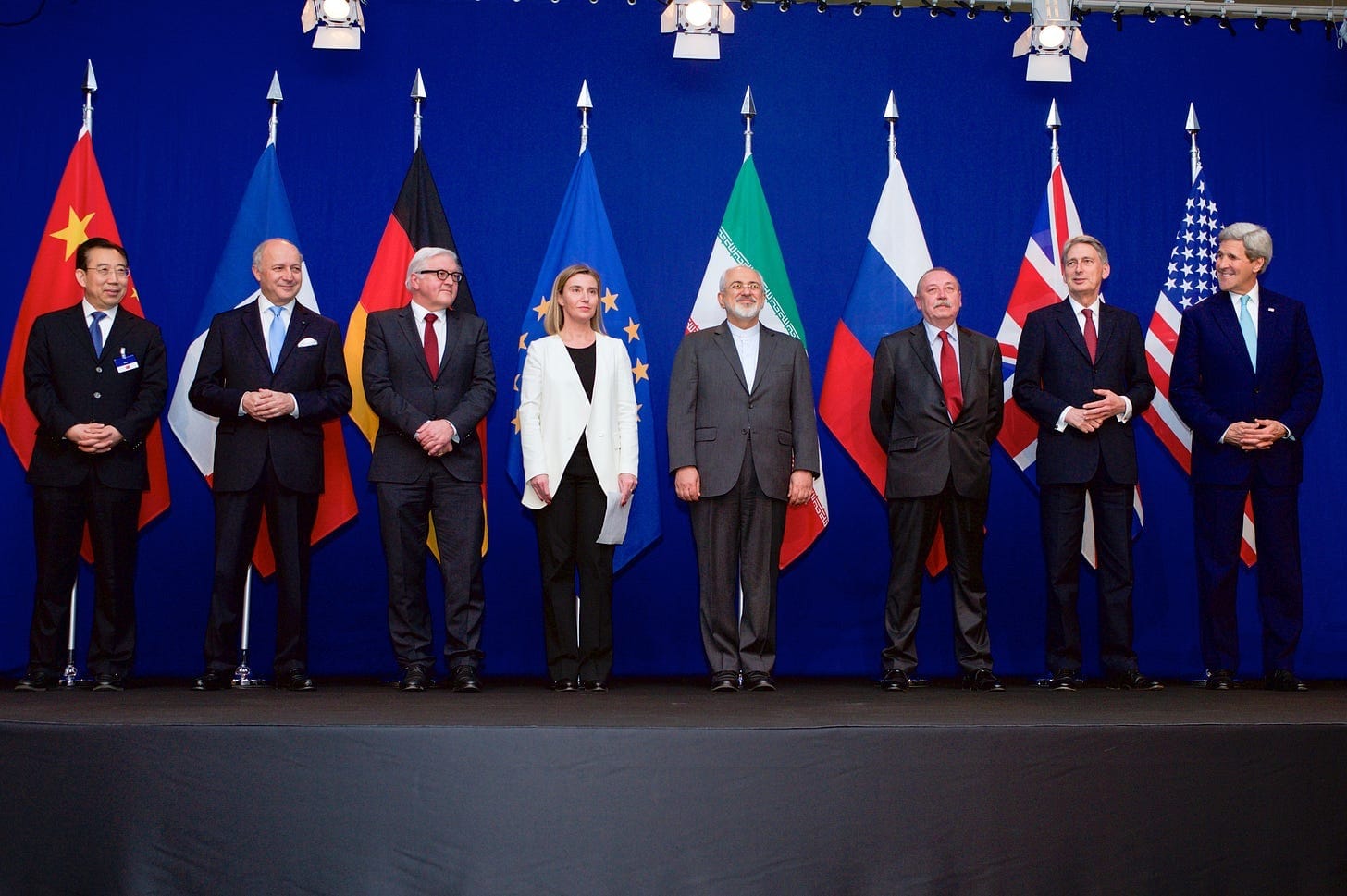
If I can sit here and realize the chance of an actual kinetic confrontation is low, so can Iran. But contrary to common belief, it is in Iran’s interest to actually have a deal as well. What’s more, Iran even made sure to have the ability to justify a deal domestically.
The key is that Iran understands that no one in the entire world wants them to have a nuke. Not the US, not Israel, not China and not Russia. They see that if they ever do a run for a nuke, they will end up like North Korea - completely dependent on China, poor and with no prospects of making the situation better. So they always said they don’t want a nuke and the enrichment is solely for civil purposes. Thanks to that, they can sign a deal that prohibits enrichment past a certain level for sanctions relief and have a simple justification for their population - the US is giving us sanctions relief for resigning from something we never intended to do.
It was a clever setup as it allowed Iran to have an ability to have a nuke quickly without risking global isolation for having one. But the underlying conditions changed - Iran is weak with its proxies defeated. There is a persistent water shortage in the country while years of sanctions started to take massive toll on the overall economy due to JCPOA totally collapsing. It is wise to even resign from having the ability to have a nuke quickly in return for sanctions relief that could help Iran rebuild the economy. Especially if Iran is allowed to maintain its ballistic missile program.
The optimal path for Iran (and Trump) is to negotiate a deal that is marginally better than JCPOA for the US. It’s not perfect for either side, but it allows Trump to tout a victory over Iran AND Obama while allowing Iran to lick its wounds and sustain the regime.
Prediction Markets
My argument essentially boils down to the fact that the Trump administration lives in a political reality. The priority will always be maintaining power. Even if a regime change operation in Iran is optimal from a long-term point of view, Trump (or any politician for that matter) doesn’t have the comfort of engaging in the long-term due to a 2-year election cycle.
He needs consistent foreign and domestic policy Ws to maintain power. Thus, especially when lacking strong domestic policy Ws, he needs a strong foreign policy portfolio to bring in the voters and improve ratings.
From this point of view, we can expect the current strong posture to be maintained and narrative to remain aggressive. At the same time, we should expect talks to progress over the course of the next few months. If I were to speculate, I would punt a phased deal where additional concessions from Iran bring them more sanctions relief, with nuclear being the cornerstone of the deal.
These phased structures the Trump administration likes so much are dismal from business perspective, as they pretty much leave the most difficult issues for further discussion, but from a political perspective they are great. They allow Trump to tout success without actually achieving anything groundbreaking. Because, after all, a marginally better deal than JCPOA is not a massive success considering everything that happened in the last 2.5 years.
Moving straight to markets, you can imagine that I’m on No side for US strikes in the short-term, as well as for Ayatollah out or regime out. I’m a buyer for end of February and end of March deadlines at this point as they offer the best APY and thus risk/reward profile. On the longer term the context can change, moving the prices significantly; my initial thesis here remains unchanged:
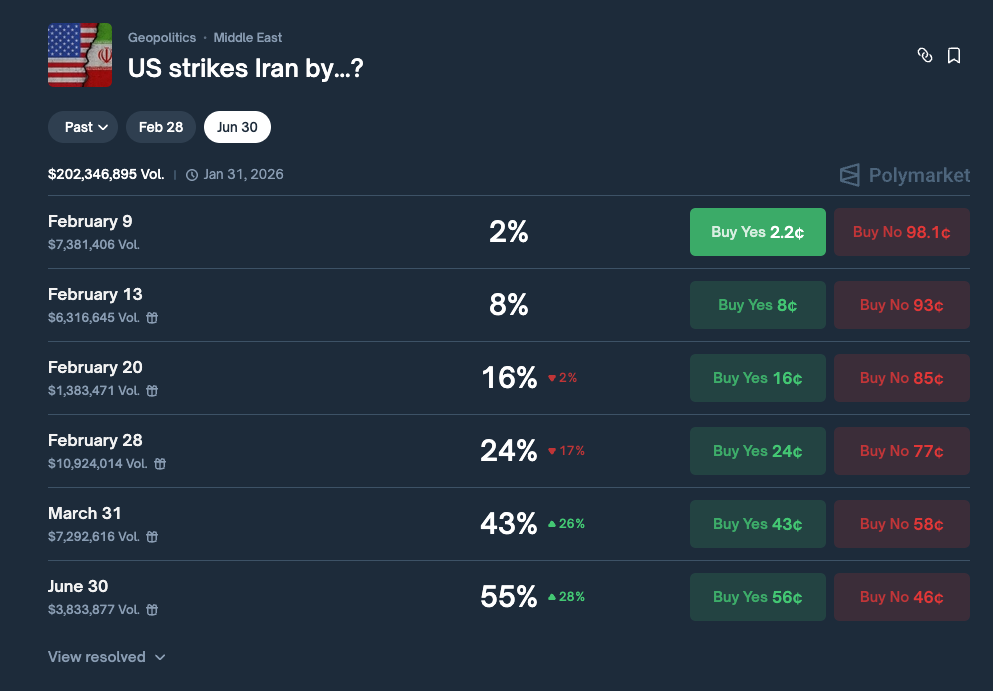
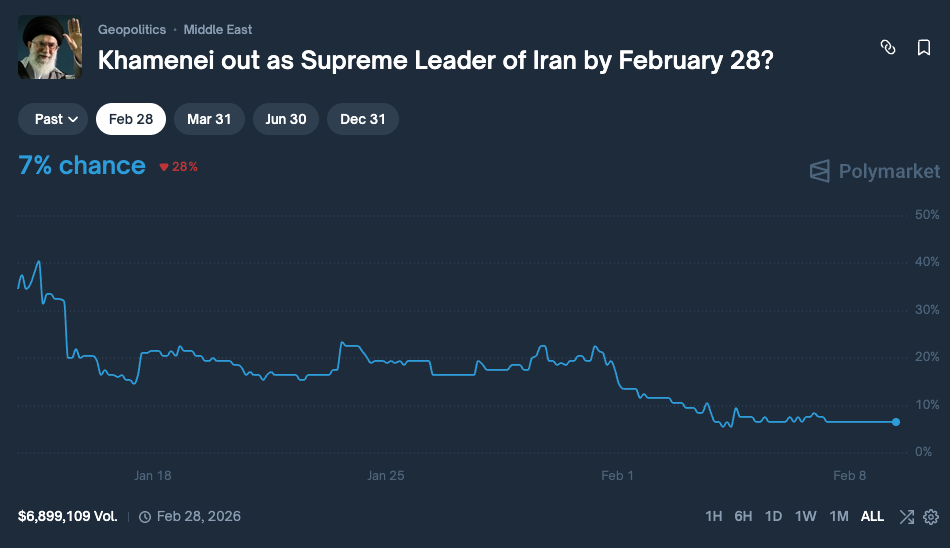
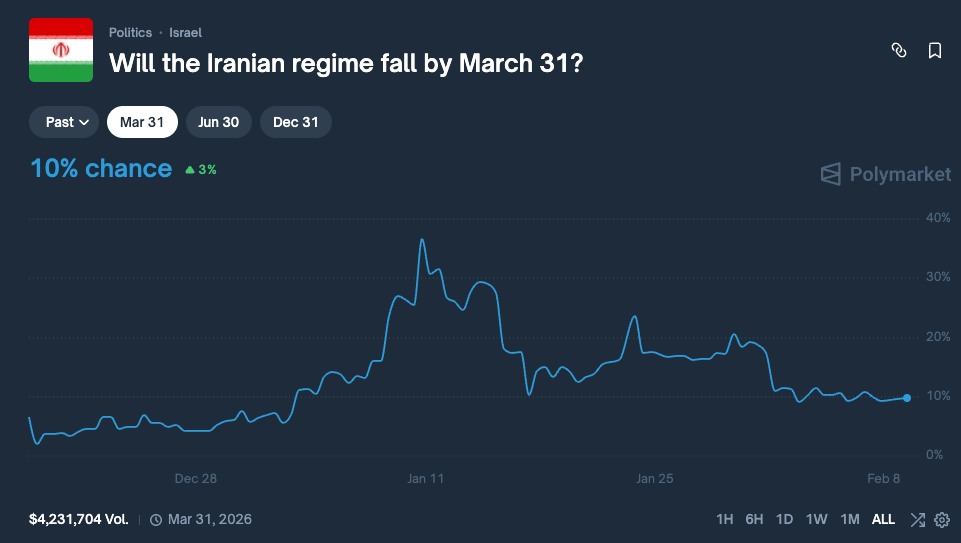
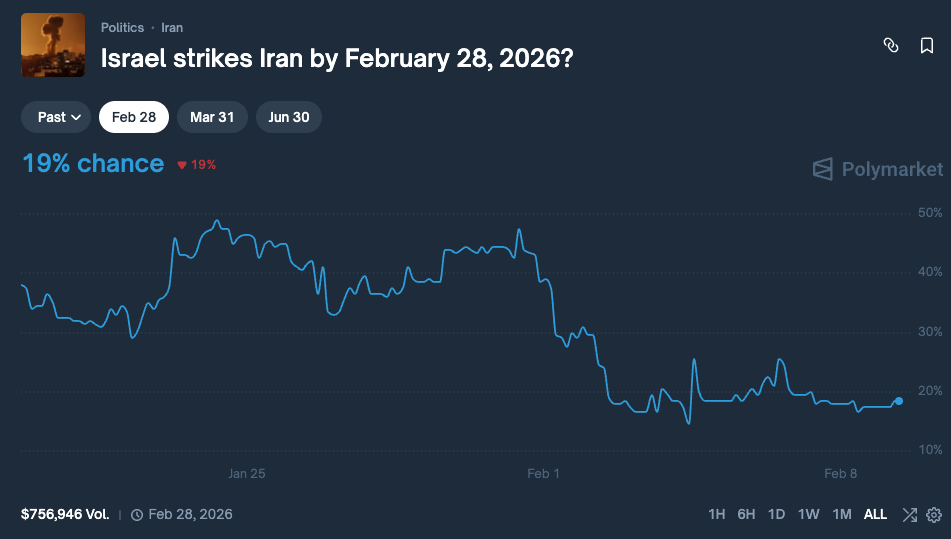
I consider markets on Israel striking Iran significantly better priced and more risky. Israel has the incentive to drag the US into the conflict, but at the same time it can’t antagonize the Trump administration (or the Congress) too much. Thus, after bidding end of January, I am no longer invested in Israel to strike Iran markets:
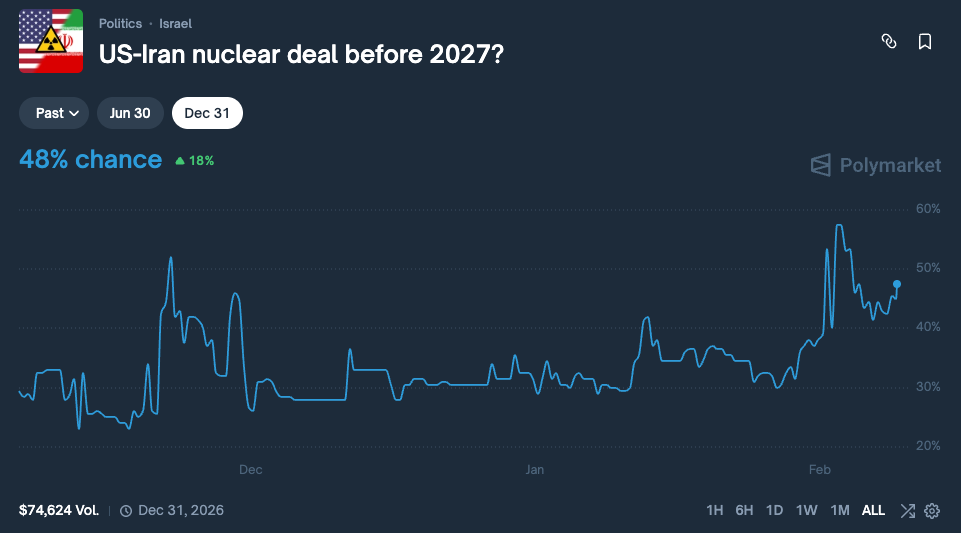
Lastly, there are deal markets. In the initial thesis I was opposing a deal as I didn’t see a short-term path forward. But now I am willing to say there is 60% chance we will see a deal by the end of the year, thus I am bidding Yes on the market, while I also closed my No position on the end of June market in favor of a small speculative Yes position:
Wrap up
I will be monitoring the situation closely, but this is the base case for the foreseeable future. I do not see any viable path towards kinetic action at this point. I will most probably do more updates as we get more updates about how the negotiations are progressing. In the meantime there is Greenland and Ukraine to focus on.
Let me know in the comments what’s your take on the current situation in Iran.